
Lawmakers in New Jersey have set their sights on the widespread use of automated license plate readers, moving to establish some of the strictest surveillance safeguards in the country. Under a newly introduced measure in Trenton, private entities would be barred from operating the devices, and government agencies would be mandated to permanently erase captured vehicle information within just two days.
The proposed legislation, designated as Assembly Bill A5483, was formally introduced on September 14 by Assemblyman David Bailey Jr., a Democrat representing Salem County. The bill seeks to impose comprehensive statutory boundaries on the deployment of automated license plate reader (ALPR) networks and curb the growing footprint of artificial intelligence-powered monitoring systems across the state.
Often identified by the prominent brand name Flock, these sophisticated camera systems automatically photograph passing vehicular traffic. The devices record not only license plate numbers but also distinctive vehicle characteristics such as make, model, and color, subsequently uploading the details into searchable digital repositories used by law enforcement and administrative bodies.
Bailey expressed deep unease regarding the intrusive nature of the technology, warning that continuous digital tracking undermines basic civil liberties. In a statement released by Assembly Democrats, the lawmaker questioned the justification for allowing artificial intelligence networks to monitor the routine travels of law-abiding citizens while amassing vast reservoirs of information that can be accessed and maintained without meaningful expiration dates.
While acknowledging that law enforcement personnel have valid operational reasons to utilize automated readers when confronting criminal activity, Bailey emphasized the necessity of statutory guardrails. He stated that the primary objective of A5483 is to establish effective oversight and strike a clear balance between public safety needs and the constitutional privacy rights of New Jersey motorists.
A central pillar of the legislation is an outright prohibition on the operation of automated plate readers by non-governmental entities. Private enterprises, property managers, and individual citizens would be prohibited from maintaining ALPR cameras, with an exception carved out exclusively for authorized equipment vendors and installers. Entities currently maintaining these units would be required to dismantle them and erase all accumulated scan records, facing civil enforcement actions by the state Attorney General if they fail to comply.
For public agencies outside the criminal justice sector, authorized usage would be sharply curtailed compared to existing standards. State entities would be permitted to deploy automated plate scanners exclusively for narrow, functional administrative tasks, such as collecting electronic toll fares, monitoring regulated parking areas, or securing entry points at restricted governmental facilities.
Police departments and the New Jersey State Police would also see their operational authority constrained under the new framework. Officers could only leverage automated camera systems in connection with official "be on the lookout" (BOLO) designations, restricting tracking inquiries to specific matters involving stolen motor vehicles, missing persons, serious felony crimes, or serious administrative violations like uninsured or unregistered driving.
To safeguard against discriminatory policing practices, the legislation expressly outlaws the strategic positioning of license plate readers to monitor neighborhoods or drivers on the basis of demographic factors. The bill prohibits any deployment intended to target individuals because of their race, national origin, religious beliefs, disability status, or other legally protected classifications.
Perhaps the most consequential provision of Bailey's proposal is a dramatic reduction in how long government databases can store everyday motorist scans. New Jersey currently permits law enforcement to maintain automated plate logs for up to three years, representing one of the most extensive retention frameworks in the United States. Across the nation, a majority of jurisdictions discard records within thirty days, and certain states require non-matching data to be purged in as little as five minutes.
Bill A5483 would fundamentally alter that landscape by requiring non-flagged license plate records to undergo automatic and permanent deletion within 48 hours of capture. Extended data preservation would be permitted only under tightly defined circumstances, including open criminal investigations, active judicial orders, or instances where a vehicle is linked to serious criminal offenses or vehicle registration infractions.
The measure also introduces strict barriers against the interstate dissemination of surveillance files. Under current practices, select regional partners and federal entities can query New Jersey's ALPR system; however, the new legislation would require out-of-state and federal agencies to secure a formal warrant approved directly by the state Attorney General before gaining access to local data.
Commercial providers of surveillance technology would face new restrictions as well, being strictly prohibited from marketing, distributing, or monetizing the data generated by their systems. Additionally, public departments operating the equipment would be subject to mandatory annual audits and public reporting rules to ensure continuous transparency.
The legislative push arrives as ALPR technology has become deeply integrated throughout the Garden State. State audit findings show that 523 out of New Jersey's approximately 530 law enforcement organizations currently utilize some form of license plate recognition, with at least 82 departments contracting directly with Flock Safety across every one of the state's 21 counties.
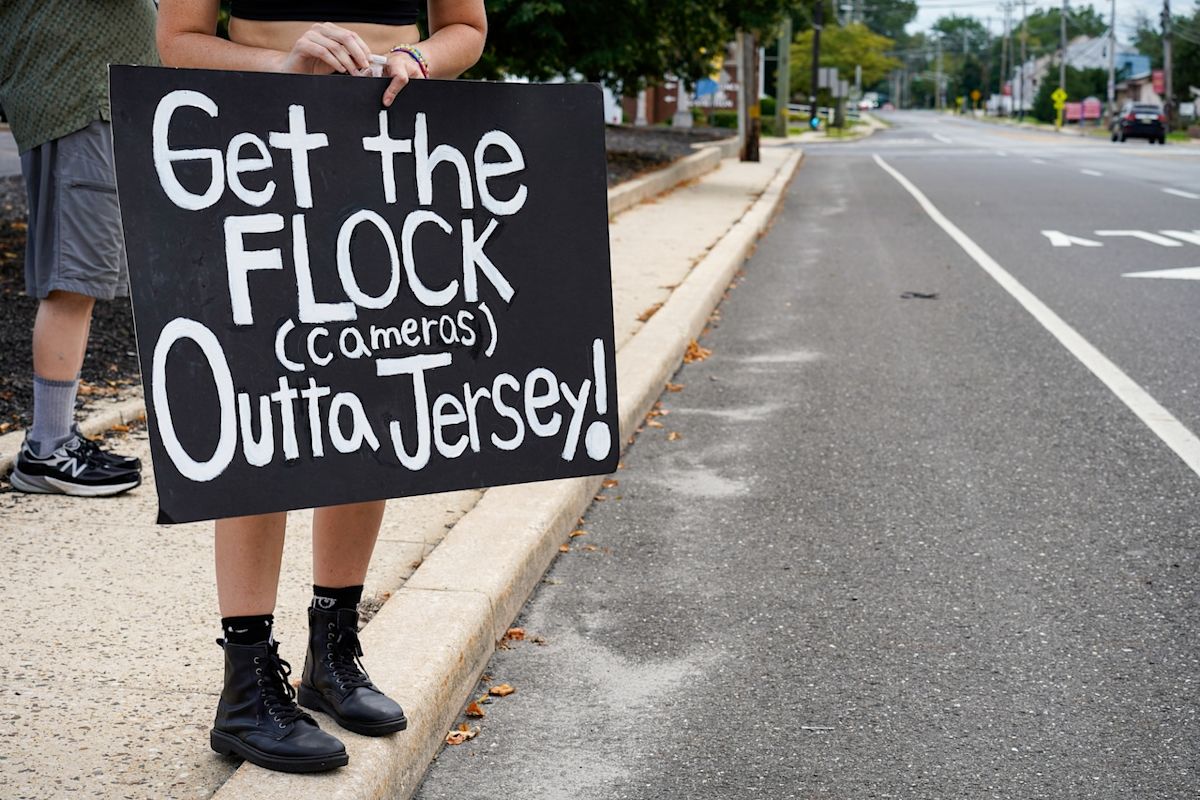
This pervasive camera presence has prompted a wave of grassroots community resistance in recent months. In Berlin Township, more than two dozen demonstrators from the advocacy group DeFlock South Jersey—accompanied by an activist dressed as a mascot named "Flocky"—rallied at a local retail center, with organizer Adam Sheridan warning about escalating mass surveillance. In Somerset County, a Franklin Township council session drew an overflow audience and an anti-surveillance petition that garnered more than 800 signatures.
Assemblyman Bailey is not the only state legislator seeking to rein in automated camera systems in Trenton. State Senator Benjie Wimberly has previously introduced a bill seeking a two-year retention cap alongside criminal penalties for technology misuse, while Senator Linda Greenstein has pushed to ban data sharing for out-of-state abortion probes, and Senator Michael Testa has outlined plans for additional legislative safeguards.









(0)