
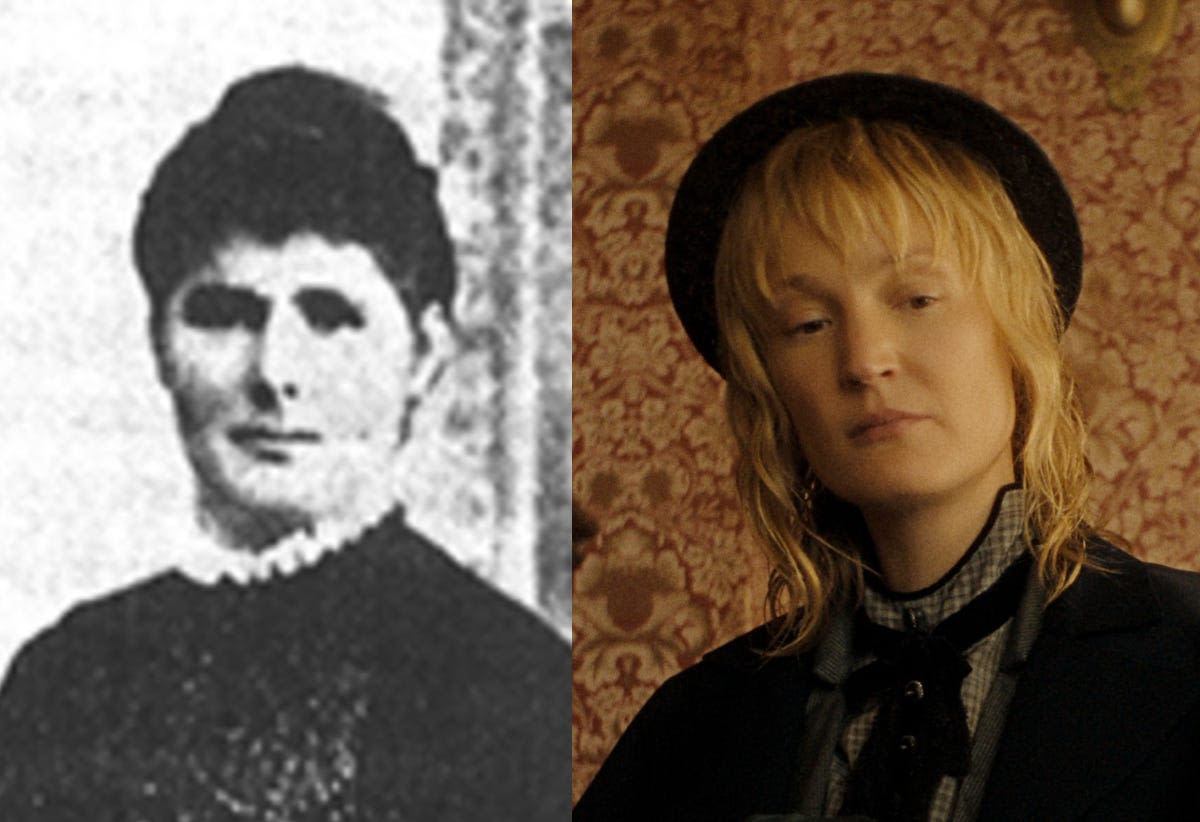
The upcoming release of producer Ryan Murphy’s true-crime television anthology series, "Monster: The Lizzie Borden Story," has reignited widespread public fascination with one of the most enduring double-murder cases in American history. The Netflix production revisits the notorious 1892 hatchet slayings of Andrew and Abby Borden at their family residence on Second Street in Fall River, Massachusetts.
In promotional material for the series, European actor Vicky Krieps is featured in the role of Bridget Sullivan, the domestic servant who found herself at the center of the gruesome tragedy. Despite portraying an Irish immigrant working in nineteenth-century New England, Krieps brings a noticeable German accent to her performance, starring opposite Ella Beatty, who takes on the role of Lizzie Borden.
The new dramatization once again places Sullivan under the cultural microscope, portraying her not merely as an eyewitness to the carnage, but potentially as an accomplice in the lethal plot. However, historical scholars and true-crime researchers have often questioned how closely modern adaptations adhere to the authenticated historical record of 1890s Fall River.
A review of archival documentation and expert historical research reveals key realities regarding the real Bridget Sullivan and her true relationship with the fractured Borden household.
Sullivan first entered the employ of the Borden family in 1889, hired as an immigrant housemaid to carry out general, relatively light domestic chores. During her three years living and working inside the Second Street residence, she became an unwilling observer of intense domestic strife, particularly the persistent hostility Emma and Lizzie Borden harbored toward their stepmother, Abby.
The interpersonal friction within the household created a deeply uncomfortable environment for the domestic worker. According to the historical volume "Parallel Lives," written by researchers Michael Martins and Dennis Binette, Sullivan made multiple attempts to leave her position with the family, only to be persuaded to stay by Abby Borden, who offered wage increases on at least one occasion to convince her not to quit.
The deep animosity dividing the Borden daughters from their stepmother was openly acknowledged in period reporting. Contemporaneous accounts published in 1892 by the Boston Post cited Sullivan as stating that Abby Borden was "too good for them" and noting that the sisters held an active and visible dislike toward her.
Another well-documented eccentricity of the Borden residence was the daughters' refusal to address the maid by her real name. Both Emma and Lizzie routinely referred to Sullivan as "Maggie," an alias that has led some modern commentators to speculate that the sisters held a dismissive attitude toward her personal identity.
However, historians note that the practice of renaming domestic servants was relatively common among wealthier Victorian-era employers, reflecting the rigid social class divisions of late nineteenth-century society rather than an exclusively personal insult.
The days leading up to the murders on August 4, 1892, were marked by severe physical distress inside the Second Street home. Due to extreme summer heat and inadequate refrigeration methods of the era, multiple members of the household suffered from suspected food-borne illness.
While popular legend has long asserted that the family fell ill from consuming spoiled mutton for breakfast, official testimony from the period revealed that the Bordens had already been experiencing acute gastrointestinal symptoms well before the mutton dish was ever prepared or served.
The lingering food illness directly impacted Sullivan on the morning of the slayings. According to her sworn testimony, Sullivan was overcome by intense nausea shortly before 9 a.m. after serving breakfast to the family, prompting her to step outside into the yard to vomit before recovering and returning indoors to wash windows—moments before Abby and Andrew Borden were struck down.
In recent decades, sensationalized depictions of the case have increasingly popularized theories suggesting an illicit romantic connection between Lizzie Borden and the family maid. Dramatic interpretations—including Evan Hunter’s 1984 novel "Lizzie," the 2018 feature film starring Chloë Sevigny, and the new Netflix series—have entertained the premise of a secret lesbian affair that inspired the pair to orchestrate the murders together.
Despite the prevalence of these narratives in modern media, historians emphasize that there is no factual or archival evidence to suggest that Sullivan was a lesbian or that her dynamic with Lizzie Borden ever crossed beyond the boundaries of a conventional employee-employer relationship.
Following the conclusion of the sensational murder trial, Sullivan permanently distanced herself from the Borden family and Fall River. After briefly traveling back to her native Ireland, she returned to the United States to start a new life away from the shadow of the Second Street murders.







(0)