
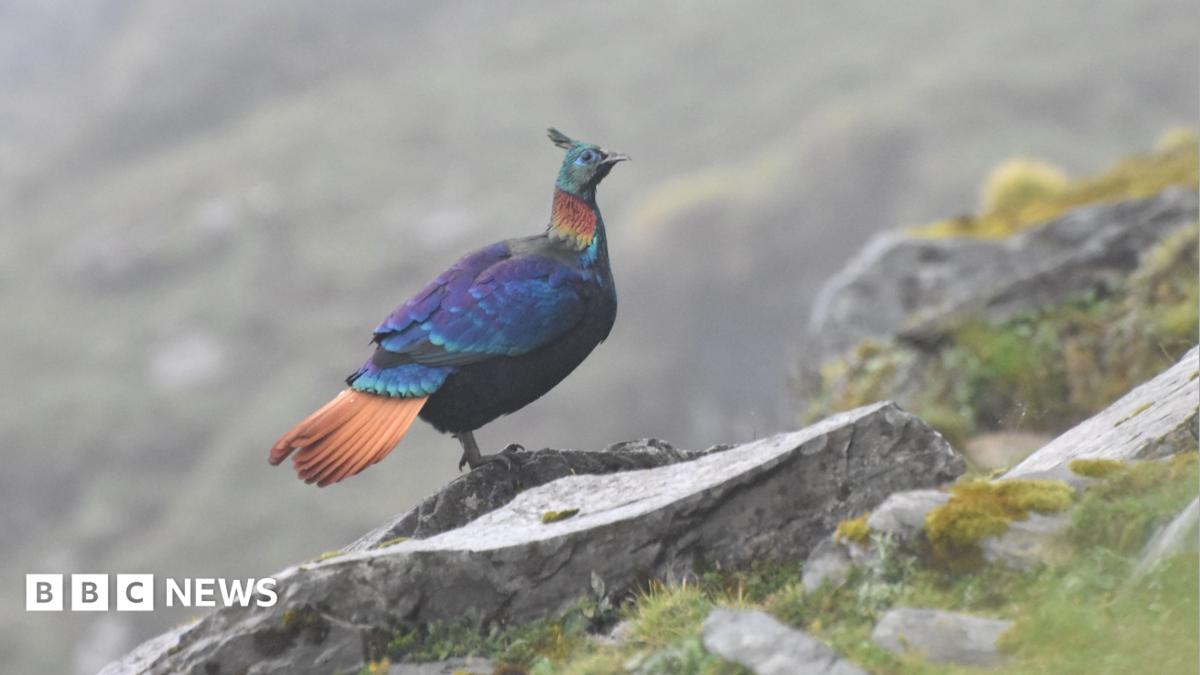
Two new studies conducted by researchers in India have found that the Himalayan monal, a striking pheasant species native to the mountain forests of the Himalayas, is being forced to change both where it lives and how it communicates as human activity intensifies across its range. The research, carried out over a five-year period in the Indian state of Uttarakhand, points to infrastructure development, expanding tourism and rising noise levels as key drivers of the bird's changing behaviour.
The monal occupies a special place in Himalayan culture. Its male is easily recognised by its iridescent plumage, which blends shades of green, blue and copper, while females are brown and white. The bird serves as the state bird of Uttarakhand in India and the national bird of Nepal, a status that reflects its deep ties to the region's folklore and sense of identity.
According to the researchers, the monal's value extends beyond symbolism. The bird moves seasonally between the lower montane zone on the mountain slopes and the high-elevation alpine meadows above the tree line, giving it a relatively narrow habitat range. Dr Rajeev Lochan, who led both studies, told the BBC that this characteristic makes the species a key indicator of ecosystem health in the north-western Himalayas. He explained that if the monal is struggling in this landscape, other birds may also be affected by the same ecological disturbances.
The first study examined how climate change could reshape the bird's suitable habitat across the Indian Himalayan region. Researchers modelled future conditions in Uttarakhand and Himachal Pradesh using the global climate models and emissions scenarios that underpin assessments by the Intergovernmental Panel on Climate Change, the United Nations' climate science body. Their projections suggest that the monal's habitat will continue to shrink and become destabilised through the year 2100 under a range of climate scenarios.
The findings indicate that the birds are already moving higher into the mountains. As snow melts and vegetation spreads upward, areas that were once inaccessible become available to them. At the same time, the alpine meadows that form their natural habitat are being encroached upon by human activity, effectively pushing the birds upward from both directions. The study assumes the monal will continue to require the climatic conditions currently found in alpine meadows, an assumption the researchers describe as reasonable but not guaranteed.
A central concern raised by the modelling is the fragmentation of the bird's seasonal migration routes. As the climate shifts, monal populations may be forced into smaller, disconnected patches of suitable terrain at higher elevations. This scattering into isolated pockets would reduce opportunities for breeding between different groups, raising the risk of long-term population decline or local extinction, a threat the study says already exists.
The second study, conducted by Lochan alongside Dinesh Kumar Sharma and Anand Kumar of Hemvati Nandan Bahuguna Garhwal University, focused on how the bird's behaviour is adapting to human-generated noise. The researchers worked in two valleys within the Kedarnath Musk Deer Sanctuary in Uttarakhand, including Chopta, a popular tourist destination known for heavy traffic. Their findings show that the monal is altering the pitch of its calls in order to be heard above the din of human activity.
This vocal shift matters because the monal relies on its call to communicate with potential mates and to signal rivalry to competitors. If background noise interferes with those signals, it can disrupt courtship and territorial interactions that are essential to the species' reproduction and social structure. The researchers describe the change in pitch as an attempt to cut through the noise in a busy valley, illustrating how even a relatively adaptable bird is being forced to modify fundamental behaviours.
Vishal Singh, an environmental practitioner who works on ecology and climate issues in the Himalayas, said the two studies together offer a warning that extends well beyond the monal itself. He noted that if a species like the monal is compelled to change both its voice and its address, more sensitive species are likely facing even greater pressure. Singh argued that the broader problem is a development model in the region that is not aligned with its ecological integrity.
The research comes amid growing concern about the cumulative effects of unregulated tourism and heavy urbanisation across the Himalayan landscape. The region has long attracted trekkers, tourists and scientists because of its scenery and biodiversity, but rapid infrastructure expansion over the past decade has opened up more areas to visitors. Increased footfall has brought new disturbances to wildlife, and mounting human pressures are combining with climate change, which is emerging as another major threat to the region's already vulnerable biodiversity.
The monal's situation illustrates how these forces interact. Infrastructure and tourism squeeze the bird's habitat, while noise pollution changes how it communicates. Climate change, meanwhile, reshapes the very terrain it depends on, compressing its range and breaking up the connections between seasonal grounds. Taken together, the studies present the monal as a stand-in for the health of a fragile mountain ecosystem that is being pushed toward a tipping point.
The researchers acknowledge that their climate modelling rests on assumptions about how the bird will respond to future conditions, and they do not claim certainty about the outcomes. Even so, they argue that the pattern of upward movement, habitat fragmentation and behavioural change is already visible. For a bird so closely tied to the identity of the Himalayas, those shifts carry implications for the wider web of species that share its alpine meadows and montane forests.









(0)