
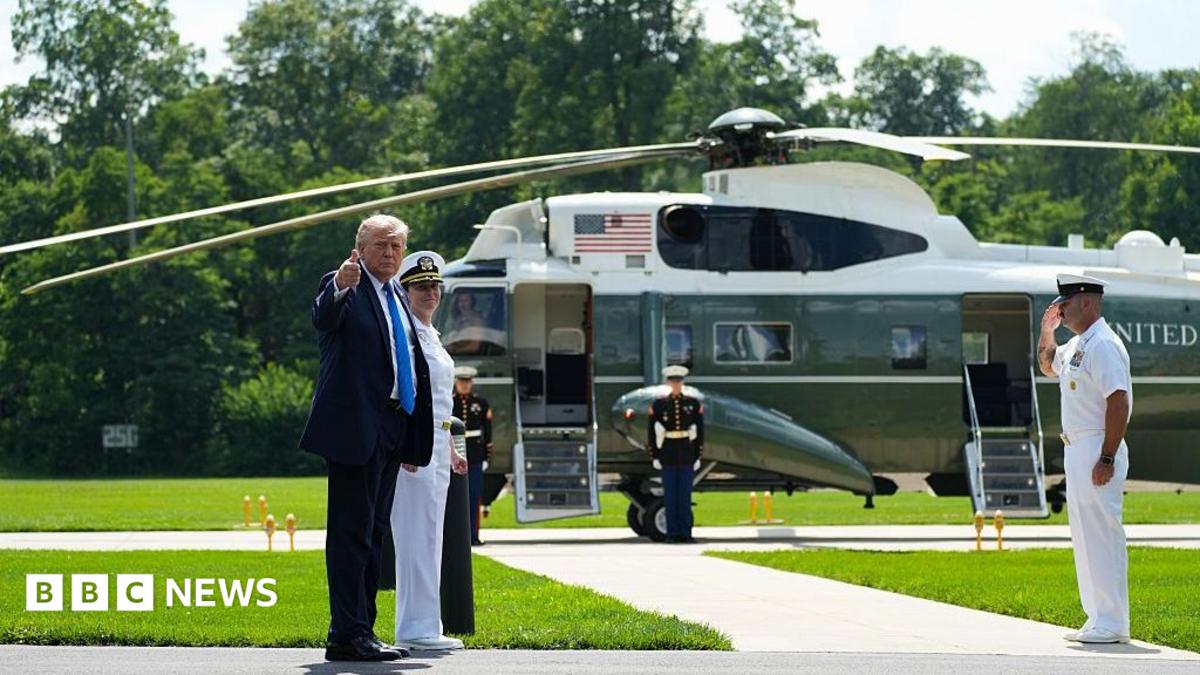
US President Donald Trump has floated the idea of establishing a presidential retreat modeled on Camp David at his own golf club in Florida, a proposal that would blend his personal business interests with the storied traditions of the American presidency. Speaking from the Oval Office on Wednesday, Trump described the concept as a convenient and highly secure alternative to the existing retreat tucked away in the Maryland mountains, suggesting that his Trump International Golf Club in West Palm Beach could serve as a weekend getaway for future commanders-in-chief and visiting foreign leaders.
Under the proposal as Trump outlined it, the club would absorb the construction costs as a "gift" to the American people. Future presidents would receive complimentary memberships, and foreign dignitaries visiting the United States could be accommodated on the grounds. Trump emphasized the club's proximity to an airport, telling reporters that it sits only about two minutes away, making it easy for a president to slip away for a weekend retreat in the style of Camp David.
The idea, if realized, would represent a striking departure from the character of the existing presidential retreat. Camp David is a rustic compound set deep within Catoctin Mountain Park in Frederick County, Maryland, originally established during the Great Depression as a camp for federal employees. President Franklin Roosevelt adopted it as a presidential getaway and gave it the nickname "Shangri-La," a reference to the mythical Himalayan paradise. The facility was later formally renamed Camp David in honor of President Dwight Eisenhower's grandson.
Officially known as Naval Support Facility, Thurmont, Camp David operates in many ways like the military installation it is. Uniformed members of the US Navy and Marine Corps staff the grounds, Marines guard the perimeter, and the airspace above is restricted. The site does not appear on maps of the surrounding national park, even though its general location is familiar to nearby residents. Press access is tightly controlled, and photographs of the wood-and-stone cabins and lodges that make up most of the complex are rarely released.
That secrecy was on display during a recent BBC visit, when reporters traveling with the White House press pool were instructed not to take images in unauthorized areas or to disclose details about the camp's layout. Over the decades, Camp David has hosted some of the most consequential diplomatic moments in American history, including the 1978 peace negotiations between Israel and Egypt and, more recently, a 2023 trilateral summit bringing together the leaders of the United States, Japan, and South Korea.
By contrast, Trump International Golf Club in West Palm Beach is a very public place. The 27-hole course is connected to the rest of the city by busy roadways, some of which are frequently lined with supporters or protesters whenever the president is in residence. The club promotes itself as offering a lively social scene and fine dining, and it features a luxurious clubhouse, a gift shop, and a steady calendar of social events for members. Trump's political allies are known to frequent the property during his many weekends in Florida.
The president's central argument for the change rests on security. He claimed that the Florida location is "about as safe as they could possibly get," noting the absence of tall buildings and nearby homes that could offer vantage points. According to Trump, the lack of surrounding high-rises means there are no windows for would-be threats to hide behind, an advantage he said would allow for maximum safety for the president and visiting dignitaries. He also said the Secret Service first raised the possibility of using the golf club as a retreat, an assertion the BBC has sought to verify with the agency.
Trump's security rationale fits a pattern that has emerged in recent months, in which he has invoked national security and public safety concerns to justify a series of building projects in Washington, DC, including an ambitious ballroom addition to the White House and a planned triumphal arch elsewhere in the capital. The president has also pursued an extensive program of altering the White House itself, adding gilded gold leaf accents to the Oval Office, demolishing the East Wing, and pressing forward with the arch project. The golf club retreat would be another entry in that broader effort to reshape the physical symbols of the presidency.
When a reporter asked whether the new retreat might be called "Camp Donald," Trump demurred, pointing out that the property already bears his name. "Well, it's already called Trump International," he replied, adding that it is one of the best golf courses in the world. He predicted the facility would see frequent use as a presidential getaway, calling the concept a great idea that would serve the country well.
The proposal raises a range of questions that remain unanswered. It is not clear how the arrangement would be structured legally, given that a sitting president would be directing official government business to a property he owns, or how ethics officials might view the gift of construction costs. A letter dated 3 September from the golf course's attorney to the relevant parties is referenced in the reporting, though its full contents and the identity of the recipient have not been detailed. The BBC has reached out to the Secret Service for comment on the origins of the idea, and no formal proposal or timeline has been announced.
For now, the concept remains a presidential suggestion rather than established policy. Still, it illustrates how Trump continues to blur the lines between his private business empire and the institutions of the presidency, and how the symbols and settings of American power may continue to change under his influence. Whether future presidents would actually spend their weekends at a Florida golf resort, rather than the wooded seclusion of Camp David, may ultimately depend on decisions that have yet to be made.




(0)