
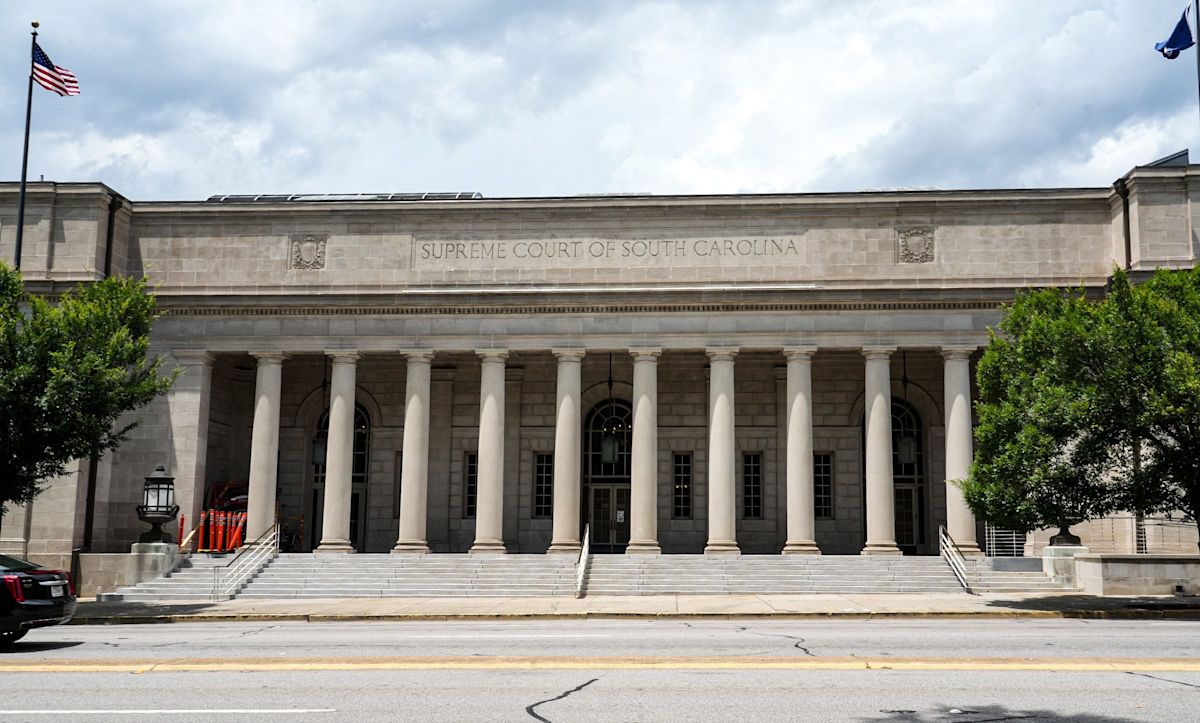
The South Carolina Supreme Court opened historic proceedings at Clemson University on September 15, hearing oral arguments in a high-profile legal dispute concerning the deployment of state National Guard troops to the nation's capital. The special session represents the first time in the state supreme court's history that oral arguments have been conducted on the Clemson campus.
The historic university setting is part of a deliberate two-day initiative orchestrated by the judiciary to foster greater civic understanding, promote institutional transparency, and make the appellate process directly accessible to members of the general public and student observers alike.
Welcoming the state's highest judicial body, Clemson University President Benjamin Ayers emphasized the profound educational impact of bringing real-world appellate proceedings into an academic environment. Ayers noted that the visiting court sessions offer an invaluable opportunity for South Carolina residents and students to observe the mechanics of the legal system up close, bridging classroom theory with the practical workings of constitutional governance.
The central matter placed before the justices on the first morning centered on a contentious challenge to Governor Henry McMaster’s 2025 decision to mobilize and send units of the South Carolina National Guard to Washington, D.C. The deployment occurred as part of an initiative led by President Donald Trump aimed at addressing and curbing crime rates in the federal district.
South Carolina’s participation was part of a broader multi-state coordination among conservative leadership across the country. Governors from several other states, including Louisiana, Mississippi, and Tennessee, similarly mobilized their respective National Guard contingents to Washington during the same period in 2025 to support the anti-crime push in the capital city.
The controversial military mobilization prompted legal action from the South Carolina Public Interest Foundation and James Weninger, a United States Navy veteran. Together, the plaintiffs filed a lawsuit naming both Governor McMaster and Major General Robert B. Stilwell, who serves as the adjutant general overseeing the South Carolina National Guard, as formal defendants.
At the core of the plaintiffs' legal challenge is the assertion that the governor overstepped his lawful authority by activating state guardsmen to carry out municipal policing and law enforcement functions in Washington, D.C. They contend that the statutes governing state military forces do not authorize the executive branch to deploy units out of state for such civilian law enforcement assignments.
During the appellate hearing, Chief Justice John Kittredge rigorously pressed the legal representation for the plaintiffs regarding the traditional scope of executive authority. The chief justice questioned whether state law vests the governor with broad, unreviewable discretion to determine precisely when and under what circumstances the South Carolina National Guard should be mobilized.
Representing the plaintiffs, American Civil Liberties Union of South Carolina Legal Director Allen Chaney clarified the precise legal question before the bench. Chaney emphasized that the lawsuit does not ask the judiciary to evaluate the wisdom or political merit of the deployment decision, but rather to strictly determine whether the governing state statute grants the governor the legal authorization to send guardsmen to Washington under those specific conditions.
The questioning from the bench also examined fundamental constitutional questions regarding the separation of powers. Chief Justice Kittredge explored whether the state court system possesses the legitimate jurisdiction to intervene and tell the executive branch how to exercise its assigned powers, to which Chaney maintained that the state constitution stands as the ultimate authority over all governmental action.
Arguing on behalf of the governor, legal counsel Grayson Lambert defended the deployment by pointing directly to the governor’s constitutional designation as the commander in chief of the state’s military forces. Lambert argued before the justices that the executive branch holds explicit and inherent authority over troop movements and military commands within this framework.
Lambert maintained that Governor McMaster acted fully within his established legal rights when ordering the guardsmen into service, arguing that the mission to Washington, D.C. fits comfortably within the governor's legitimate constitutional and statutory authority. After approximately one hour of intense oral arguments, the justices concluded the hearing without issuing an immediate ruling on the legality of the 2025 deployment.
Beyond the military mobilization dispute, the Supreme Court's docket at Clemson included a second matter on September 15 involving reality television personalities Thomas Ravenel and Kathryn Dennis, known for their appearances on the Bravo program "Southern Charm."
The high court's two-day schedule at Clemson continues on September 16 with oral arguments scheduled across two additional distinct legal disputes. One matter originates from Horry County and addresses critical criminal procedural questions surrounding a defendant’s fundamental right to testify during trial proceedings.
The final matter scheduled for the university session is a civil product liability lawsuit emerging from Anderson County. That case involves claims for damages following an incident in which a consumer sustained injuries when a lithium battery unexpectedly exploded.
As the South Carolina Supreme Court concludes its historic visit to Clemson University, the pending determination in the National Guard case remains the most closely watched matter, carrying potential long-term implications for the statutory boundaries of gubernatorial military power in South Carolina.




(0)