
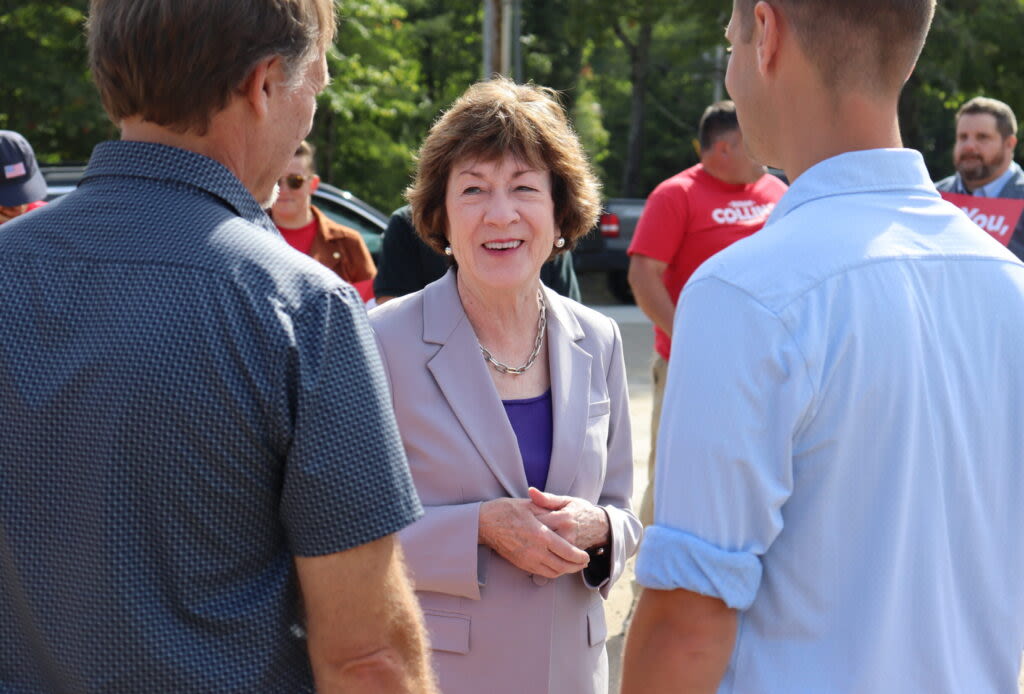
A campaign bus bearing the bold declaration "Susan Collins Our Senator" rolled into the driveway of a longstanding multi-generational aggregate company in Naples, marking yet another stop in the five-term Republican’s re-election effort. As local business proprietors, employees, and area residents gathered with campaign signs in hand, the incumbent senator stepped out to connect directly with the small crowd, relying on an intimate retail-style approach that has anchored her political career for nearly three decades.
During the visit to P&K Sand and Gravel, an enterprise moving into its fourth generation of family stewardship, Collins greeted roughly twenty attendees individually. Taking time to inquire about individual operations and exchange recollections about mutual local acquaintances, she underscored her personal affinity for local commerce. Collins noted that her own background rooted in a family enterprise gives her a deep appreciation for such operations, describing them as the true heart and soul of the state of Maine.
These modest community-centered gatherings form the core operational blueprint of Collins' re-election bid as she heads toward the November 3 election. Rather than dedicating her campaign to introducing herself anew to the electorate or delivering sweeping broadsides on national platform issues, the senator is doubling down on her established record. Her messaging across small gatherings and campaign advertisements consistently highlights her ability to deliver targeted federal funding directly to local municipalities, schools, and organizations across the state.
A recurring theme of her stops is her work in securing federal dollars, including efforts where she has actively reclaimed funding from President Donald Trump's administration to assist Maine entities. Collins has sought to demonstrate that her institutional knowledge and leadership positions in Washington translate into tangible local benefits, attempting to separate her legislative utility from the broader national political environment.
This argument appears to resonate among a segment of non-traditional supporters. Among those gathered in Naples was Kevin Rogers, a registered Democrat who maintains steadfast support for the Republican incumbent. Rogers observed that while some critics may question her lengthy tenure in Congress, that very seniority is precisely what provides the leverage required to achieve concrete legislative and budgetary results for the state.
The concrete benefits of her legislative output were prominently praised by the hosts of the Naples event. Corey Mitchell and his mother, Colleen Foster, co-owners of P&K Sand and Gravel, highlighted Collins’ lead sponsorship of the 2020 Paycheck Protection Program, a relief measure enacted to help small business owners maintain payroll during the COVID-19 pandemic. According to Foster, the fully forgiven federal loan was instrumental in preventing the company from being forced to lay off roughly half of its workforce during the crisis.
Beyond federal relief programs, attendees and company leadership pointed to the value of direct constituent services provided by Collins and her staff. Foster cited the senator’s direct intervention when the company encountered what they viewed as unjust regulatory inspections at their operational quarry. Such individual casework and responsiveness have remained central pillars of the loyalty Collins continues to command among local business operators across the state.
The gathering also served as the backdrop for formal political backing, as Mitchell presented Collins with an endorsement from the National Federation of Independent Business. Addressing the crowd in front of work vehicles bearing campaign signs, Mitchell commended Collins for choosing pragmatic cross-aisle problem-solving over contentious partisan rhetoric, arguing that the nation’s capital urgently needs leaders focused on quiet competence rather than vocal complaints about institutional dysfunction.
While Collins maintains a steady schedule of local events, substantial responsibilities await her return to Capitol Hill. Serving as chair of the powerful Senate Appropriations Committee, her authority during Trump’s second presidential term is facing an immediate test. Lawmakers face a tight 16-day window to negotiate federal spending and prevent a looming government shutdown, all while attempting to finalize unfinished legislative business before the upcoming midterm contests.
These legislative hurdles coincide with standard historical patterns, as the political party occupying the White House almost universally suffers losses during midterm election cycles. For Collins, managing committee responsibilities amid shifting legislative currents while simultaneously distancing herself from the polarizing influence of the president represents a delicate balancing act.
Meanwhile, her Democratic challenger, Troy Jackson, has advanced a sharply contrasting narrative regarding her tenure. Jackson, a logger hailing from Allagash and the former president of the Maine Senate, contends that Collins' high-profile standing atop the Appropriations Committee cannot obscure her voting history. Jackson argues that she has supported Trump administration measures the vast majority of the time, contending that those very federal policies have ultimately cost the state of Maine millions of dollars.
To counter Collins' formidable financial advantage and extensive war chest, Jackson has been forced to depend heavily on an aggressive grassroots ground game. Operating on a compressed campaign timeline, the Democratic nominee has worked to capture and expand upon the initial momentum generated by Graham Platner, the party’s former nominee who previously exited the Senate contest.
Faced with this grassroots challenge and complex federal dynamics, Collins has refrained from radically shifting her long-standing campaign style. Her strategy instead avoids deep involvement in national ideological disputes, focusing strictly on local constituent relationships, concrete municipal investments, and an intentional distance from Trump.
As the race moves into its final stretch, Collins is wagering that her nearly 30-year record of federal funding delivery and constituent assistance will prove sufficient to overcome political headwinds and secure another term in the United States Senate.








(0)