
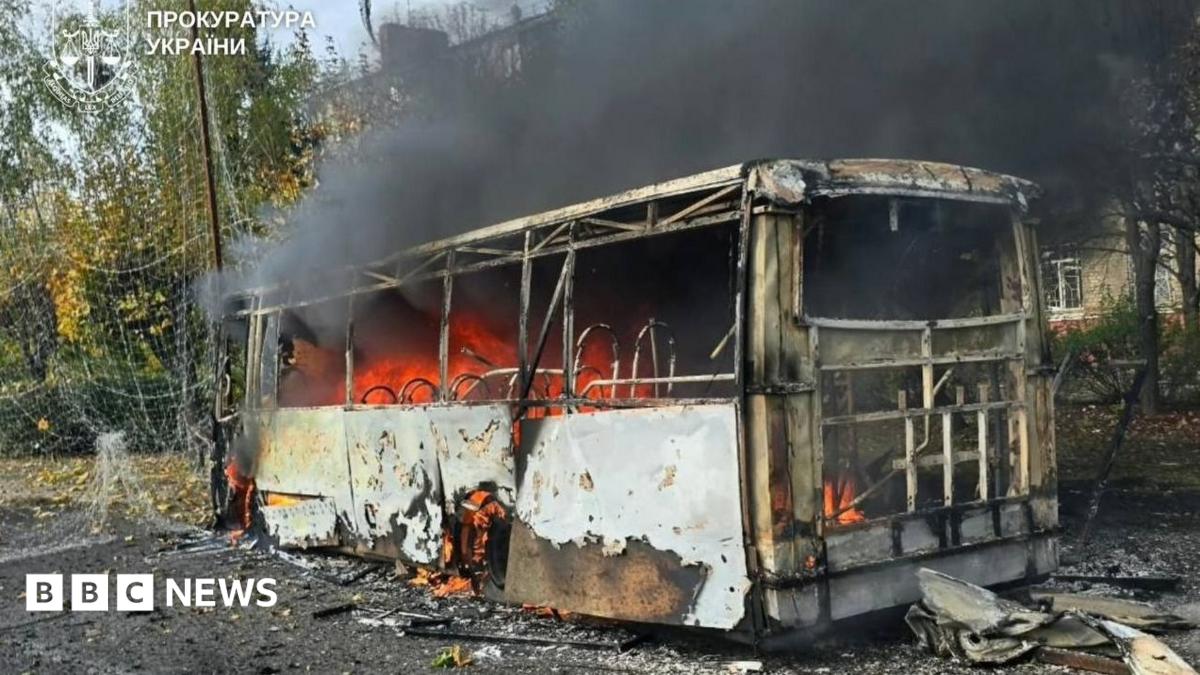
At least 30 people lost their lives when Russian glide bombs struck two civilian buses in the eastern Ukrainian city of Kramatorsk, according to rescue officials, in one of the deadliest single incidents to hit the front-line community in recent months. Authorities additionally reported that three people were killed in the village of Bilenke, which forms part of the wider Kramatorsk community, bringing the combined death toll to at least 33.
Donetsk regional head Vadym Filashkin said a further 18 people were wounded in the strike, and accused Russia of deliberately targeting buses carrying passengers in order to inflict the maximum possible number of civilian casualties. Local prosecutors released images showing the burning metal shell of one bus, with flames visible inside and black smoke pouring from the wreckage, as debris and the bodies of victims lay scattered across the road.
Ukrainian President Volodymyr Zelensky responded to the attack with a forceful statement posted on Telegram, vowing that the strike would not go unanswered. "Russia is trying to destroy all life in Donbas, and the world needs to react to this," he wrote, calling on the international community to respond harshly, in a manner he said the Russians deserved for all the deaths they have caused. He also said Kyiv's allies needed to take concrete action rather than offering only words of sympathy.
The Kramatorsk city council described the incident as a horrific crime committed by the Russian army against the civilian population. In a statement, the council insisted that Russian forces had once again struck a location where there were absolutely no military targets, rejecting any suggestion that the buses or their passengers represented a legitimate military objective.
The strike comes amid a dramatic surge in Russian attacks across Ukraine and a sharp increase in civilian casualties. According to United Nations figures, more civilians were killed in Ukraine by August of this year than during the whole of 2025, underscoring what analysts describe as a marked escalation in the scale and lethality of Moscow's aerial campaign.
Kramatorsk and the neighbouring city of Slovyansk form part of what Ukrainian officials call a fortress belt, a chain of heavily fortified urban centres that Moscow is attempting to seize as part of President Vladimir Putin's stated ambition to control the entire industrial Donbas region. The Kremlin has frequently invoked the liberation and protection of the predominantly Russian-speaking Donbas as justification for its full-scale invasion, launched in 2022, a claim that Ukraine and its Western allies have consistently dismissed as baseless.
The Donbas comprises two regions, Luhansk and Donetsk. With most of Luhansk already under Russian control, Moscow's forces are now focused on capturing the remaining roughly 20 per cent of Donetsk territory still held by Ukraine. For much of the war, Kramatorsk served as a critical logistics and supply hub for the Ukrainian military, but it has come under near-daily Russian attack as Russian troops advance closer to the city's eastern approaches.
Glide bombs, which are fitted with winglets allowing them to glide toward their targets rather than simply falling, have been used repeatedly against both Slovyansk and Kramatorsk. In late August, as many as nine glide bombs were fired at Kramatorsk in a single day, according to officials, illustrating the intensity of the bombardment endured by civilians in the region.
In the aftermath of the attack, Filashkin appealed to anyone still remaining in the eastern front-line region to relocate to safer parts of Ukraine. Citing the sharp deterioration in security across the two neighbouring cities, he announced that all public transport had been ordered to halt operations. He said the safety of civilians was paramount and that authorities had no right to risk the lives of passengers and drivers.
The assault on Kramatorsk followed another devastating strike earlier in the week, when a Russian attack destroyed a five-storey apartment block in Pryluky, east of Kyiv. That attack killed 22 people, including five children, three of whom were only one year old. The image of children killed while they slept has become a symbol of the human cost of the renewed Russian offensive against Ukrainian cities.
UK Foreign Secretary Ed Miliband, who visited the site of the Pryluky strike alongside Zelensky, said the attack demonstrated Putin's evil intent and evil strategy. He announced a package of additional sanctions targeting Russia's war machine, its shadow fleet of tankers, oil companies, cryptocurrency networks and the financing of the war, and assured Zelensky that the UK would stand with Ukraine for as long as it takes for the country to prevail in the conflict.
Russian attacks on Kyiv have also intensified in recent weeks, with air raid sirens sounding almost continuously. On Thursday, Kyiv police reported that four people were killed and two injured in the latest strike on the capital. The attacks are forcing schoolchildren out of classrooms and into underground shelters, shuttering businesses and disrupting public transport across the city.
Moscow's strikes on Ukraine's critical infrastructure, particularly the energy grid, are already causing power outages and are beginning to affect the water supply. Local water authorities in Kyiv warned on Thursday that pressure was dropping across the city's right bank because of the power cuts. The capital's metro network, relied upon by millions of residents, briefly halted all train traffic due to a voltage drop from external power centres, though trains later resumed at longer intervals, local officials said.
Zelensky offered his condolences to the families and loved ones of those affected by the latest attacks and reiterated his appeal to Ukraine's partners to provide concrete action through new defence packages aimed at protecting the country. His remarks reflected a growing frustration in Kyiv that declarations of solidarity from Western capitals have not yet translated into sufficient air defence systems and long-range weapons to shield Ukrainian cities from the relentless bombardment.







(0)