
At least 52 civilians have lost their lives in three days of intense combat around the town of Alamata in Ethiopia's northern Tigray region, according to hospital sources who spoke to the BBC. The deaths, which include children as young as three days old, mark one of the deadliest episodes since fighting resumed last week between federal government troops and regional forces, threatening to unravel a fragile peace agreement that had held for nearly two years.
Medical staff at Alamata General Hospital, who requested anonymity for their own safety, reported that the violence unfolded between Saturday and Monday, involving heavy explosives and artillery fire. Some of the munitions struck residential homes, catching civilians in the crossfire. Among the dead were mothers and cattle herders, as well as infants, underscoring the devastating impact on non-combatants who had no involvement in the hostilities.
The scale of the suffering extends beyond Alamata. The medical charity Médecins Sans Frontières (MSF) has reported that more than 700 wounded individuals have been admitted to hospitals it supports across Tigray in recent days. That figure likely represents only a fraction of the true toll, as communications to the region remain severely restricted and the BBC is unable to report directly from Tigray or its surrounding areas.
The current outbreak of violence follows months of mounting tension between Ethiopia's federal government and the Tigray People's Liberation Front (TPLF), the party that administers Tigray. Both sides have accused each other of violating the Pretoria agreement, the 2022 deal that ended a devastating two-year civil war which killed hundreds of thousands and displaced millions. The resumption of hostilities has raised fears that the region could plunge back into a full-scale conflict.
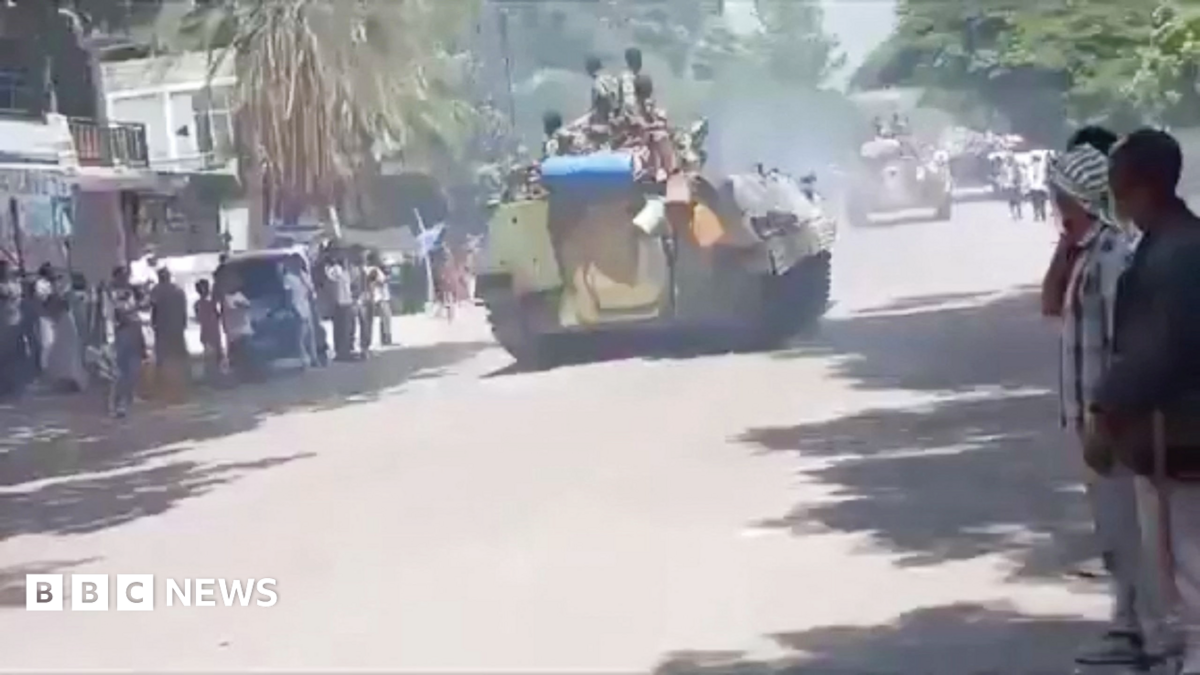
According to hospital sources and social media footage, government troops appear to have seized control of Alamata and are preparing to push northward toward Mekelle, Tigray's regional capital. Videos circulating online show army tanks and armored vehicles moving through the town's streets, a visible sign of the federal military's advance. The strategic objective appears to be consolidating control over key urban centers and supply routes.
A separate source in Alamata described a deteriorating humanitarian situation to the BBC, explaining that the town has become overwhelmed by an influx of people fleeing violence in surrounding areas. "All the residents of the surrounding areas entered the town of Alamata by walking on foot for as long as an hour, hoping the town would be safe," the source said. Instead, they found essential services completely paralyzed. Banking has been suspended by the government, and access to the internet has been cut, though it remains unclear who ordered the communications blackout. There is no money transfer, no electricity, no phone service, and no internet. "People are in crisis, simply suffering, everyone is desperate and frustrated," the source added.
The fighting has also spilled into neighboring regions, most notably affecting the historic town of Lalibela in the Amhara region. A British tourist, who asked not to be named, told the BBC's Newsday program that the area had endured a week of continuous combat. "We have heard fighting, gunfire and artillery cannons firing throughout the week," he said. Lalibela is a Unesco World Heritage site famous for its 13th-century rock-hewn churches and remains a holy site for millions of Orthodox Christians.
The tourist described a substantial military presence in Lalibela, with a larger force observed departing the town and heading north. The town's airport closed to commercial flights last Wednesday, leaving 33 tourists stranded for the past week. While the situation has calmed somewhat in the last two days, indications suggest the airport might reopen on Thursday, though it is still being used by the military. The local population remains fearful of what may come next.
Some foreigners have managed to escape. Fourteen Israeli tourists were evacuated by military helicopter on Monday, and another five left the previous day via a humanitarian convoy despite warnings against traveling by road. When the airport first closed, 53 tourists were in the town. The remaining group is diverse, including Americans, Israelis, Britons, South Koreans, South Africans, an Ethiopian-New Zealander, and a Mexican, according to the British tourist. Online banking is still functional in Lalibela, but there is a shortage of physical cash, adding to the uncertainty for those still trapped.
The conflict's complexity is deepened by shifting alliances among armed groups. A militia from the Amhara region has joined forces with Tigrayan fighters, and in early September, they united with other Ethiopian armed movements to form a seven-member alliance. This coalition has publicly stated its intention to remove the government in Addis Ababa, signaling a broadening of the conflict beyond Tigray's borders. TPLF fighters are also reportedly engaged in the Afar region, a strategically vital corridor that connects landlocked Ethiopia to the ports of Djibouti, which handles the vast majority of the country's trade.
There is growing concern that Eritrea could be drawn into the conflict. The Ethiopian government has accused Asmara of supporting the armed groups, a charge Eritrea denies. Any direct involvement by Eritrea would significantly escalate an already volatile situation in the Horn of Africa, where regional powers have long vied for influence. The international community has yet to mount a coordinated response to the renewed fighting, and diplomatic efforts to broker a ceasefire appear stalled.
The two warring sides continue to offer conflicting accounts of how the latest round of violence began. The TPLF claims it was responding to a federal offensive that included drone strikes, while the government insists Tigrayan forces attacked first after seizing control of airports in the region. With communications cut and independent verification impossible, the competing narratives remain unresolved, further complicating any potential path to de-escalation.
For families cut off from loved ones in Tigray because of the telecommunications shutdown, the Tigray Broadcasting Service (TBS), based in Addis Ababa, has launched an initiative to help reconnect people. The broadcaster is collecting video messages through its Telegram channel from individuals outside the region and airing them via satellite television. While limited to greetings and short updates, the effort reflects the deep need for connection amid the information blackout.
The situation remains fluid and dangerous. Aid agencies warn that humanitarian access is severely constrained, and the suspension of banking services has left many without the means to purchase food, medicine, or fuel. If the fighting continues to spread and government forces press toward Mekelle, the civilian toll is likely to rise, and the prospects for a durable peace in northern Ethiopia will grow ever more distant.





(0)