
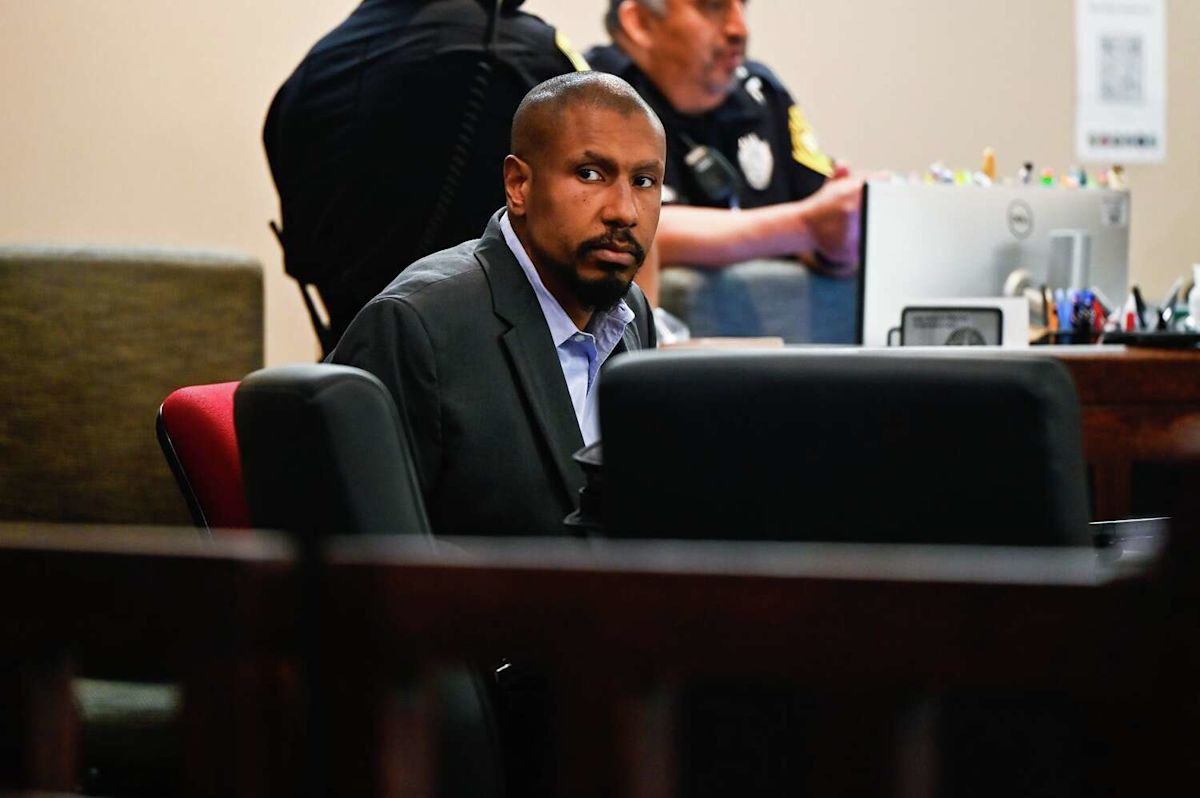
A San Antonio man has been sentenced to spend the remainder of his life behind bars following his capital murder conviction in the brutal 2019 killing of his Bexar County jail cellmate. A jury found 39-year-old Shandrick Van Anthony Buckley guilty on Tuesday evening after deliberating for several hours over the fatal attack that left his cell partner dead on the floor of their shared cell.
The verdict concluded a trial that began the previous week in the 226th Judicial District Court. Jurors retired to deliberate shortly before 4 p.m. on Tuesday. As discussions stretched past 6 p.m., state District Judge Benjamin Robertson instructed court deputies to begin arrangements to sequester the panel. However, jurors notified the court that they had reached a unanimous guilty verdict shortly before 9 p.m.
Because the Bexar County District Attorney’s Office chose not to seek the death penalty in the capital case, Judge Robertson immediately handed down the mandatory sentence of life in prison without the possibility of parole. The conviction permanently resolves the case stemming from the deadly incident that unfolded inside the county facility more than five years ago.
The fatal altercation occurred on May 30, 2019, inside cell C23 at the Bexar County jail. At the time of the incident, Buckley was already incarcerated and awaiting trial on a separate murder charge connected to the alleged fatal stomping of an individual behind the Haven for Hope facility two years earlier in 2017. While awaiting proceedings on that case, Buckley was assigned to share a cell with 29-year-old Alexander Wise.
Wise was being detained in the facility on charges related to credit card fraud and narcotics. The pairing quickly turned catastrophic when detention officers conducting a routine inspection discovered blood pooling out from beneath the threshold of cell C23. Upon entering the locked quarters, jail personnel discovered Wise lying completely unresponsive in a pool of blood near the doorway.
First responders and detention staff were unable to revive Wise, who was pronounced dead inside the detention facility. Witnesses during the trial described a graphic crime scene, recounting that blood was spattered across the cell walls up to waist height. Jurors were shown extensive photographic evidence and body camera recordings captured by responding detention officers that documented the aftermath of the lethal encounter.
Medical personnel who rushed to the scene detailed the extensive trauma inflicted upon the victim. Howard Huber, a physician assistant who attempted to administer life-saving measures to Wise, testified regarding the catastrophic injuries observed on the inmate. Huber noted that Wise sustained a severe Le Fort fracture, a critical midfacial trauma that separates the upper jaw and facial bones from the base of the skull, resulting in a condition referred to as a "floating face."
A post-mortem examination performed by the Bexar County Medical Examiner’s Office officially ruled that Wise died from extensive blunt force injuries inflicted upon his head and neck. The findings supported the state’s contention regarding the overwhelming physical force deployed during the fatal confrontation.
During closing arguments, Bexar County Assistant District Attorneys Raul Jordan and Cassandra Rosales characterized the killing as an unprovoked ambush. Prosecutors argued that Buckley viciously beat Wise into a state of total helplessness and then stomped him to death. While the state did not establish a specific motive for the assault, prosecutors emphasized the sheer brutality documented by investigators.
The prosecution also highlighted admissions Buckley made during an interview with investigators following the killing. In that interview, Buckley acknowledged that he had repeatedly punched and stomped Wise. When investigators questioned him about the physical mechanics of the stomping, Buckley told authorities he used his foot in a manner resembling someone attempting to put out a fire.
Prosecutor Jordan presented diagrams from the medical examiner to emphasize that Buckley had no defensive wounds or visible physical injuries on his body after the attack. By contrast, investigators found blood coating Buckley’s footwear, garments, and legs. Jordan argued to the panel that the complete absence of injuries on Buckley demonstrated that he launched a one-sided assault, knocking Wise to the floor before executing the fatal stomping.
Buckley’s defense team, led by attorneys Cleophus Marshall and Cornelius Cox, sought to raise reasonable doubt by emphasizing the total lack of eyewitnesses to the start of the altercation. The defense argued that because only two individuals were locked inside the cell, the state could not conclusively disprove that Buckley may have acted in lawful self-defense during an unexpected fight.
Marshall raised questions about jail classification procedures, pointing out that Wise was an identified member of the Aryan Brotherhood, a white supremacist prison gang. The defense attorney questioned why jail administrators placed a documented member of a neo-Nazi organization into a confined cell with Buckley, who is Black. Marshall noted that Wise had already engaged in an altercation with another inmate prior to being transferred into Buckley's cell.
The defense attorney further argued that Buckley, who had been involved in 23 separate fights during his time in detention, likely anticipated hostile encounters. Marshall drew attention to crime scene evidence showing that the bunk where Wise was supposed to sleep was missing a mattress, suggesting to the jury that the placement may have been tied to an illicit inmate "fight club." Marshall supported this theory by citing trial testimony from a former Bexar County detective, who stated that inmates were permitted to engage in physical fights.
Throughout the legal proceedings, Buckley’s defense counsel repeatedly brought up their client’s shifting mental state, noting that his competency to stand trial had fluctuated back and forth since the 2019 killing. Buckley had originally entered a plea of not guilty by reason of insanity at the start of the trial; however, the jury received instructions stating that they could not factor an insanity defense into their deliberations, ultimately leading to his capital murder conviction and life sentence.





(0)