
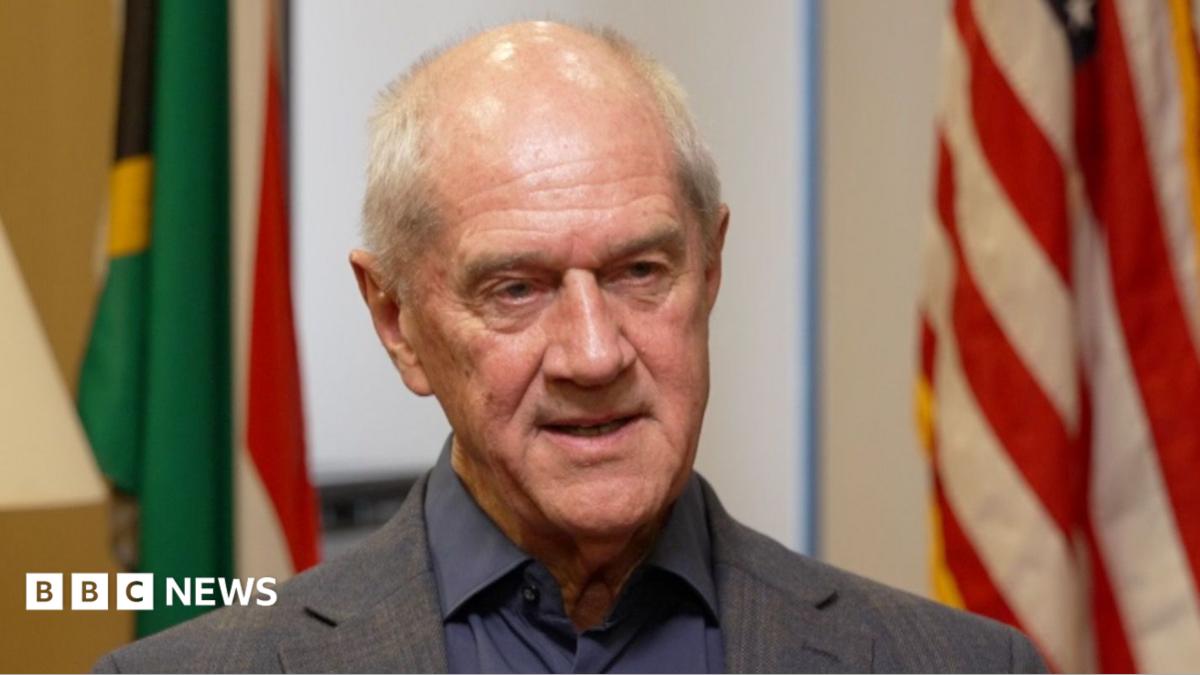
South Africa's newly appointed ambassador to Washington has rejected President Donald Trump's assertion that white Afrikaners are being targeted for annihilation, arguing that the envoy's own heritage gives him the standing to say so. Roelf Meyer, who took up the US posting in April, told the BBC that the idea of a mass attack on the white Afrikaner minority simply does not exist, and that the facts on violence in his country have been presented to the world in a distorted way.
Meyer's background is unusually direct for a diplomat holding his portfolio. He was one of the chief mediators who negotiated the end of white-minority apartheid rule in the 1990s, doing so on behalf of the National Party — the party that built and enforced the apartheid system — while Cyril Ramaphosa, now president, was a key negotiator for the African National Congress. Meyer said the personal trust between the two men, built during those talks, was one reason Ramaphosa chose him to help repair strained US-South African relations, alongside what he called Ramaphosa's recognition of the value of having a credible Afrikaner face the White House.
His personal stake in the dispute was immediate. Meyer recalled that his first thought on hearing the US president's remarks was to ask whether the comments were really about people like him and his community. His answer now is unequivocal: as an Afrikaner born and raised in South Africa, he said, he has never encountered anything resembling a campaign aimed at the destruction of his people. He also said he would welcome a direct conversation with Trump about the realities on the ground, arguing that his background gives him the legitimacy to speak on the subject.
The ambassador said he has sought, without success, to establish where the claims originated. In his account, he has never received a clear answer about the source of what he termed a "misdirection of information" that displaced genuine South African crime statistics with a far more dramatic narrative. That claim of a systematic political drive, he stressed, has been rejected by every political party in South Africa, including parties that speak for Afrikaner voters.
Trump's position has hardened considerably since the dispute began. The president raised the accusation of a white genocide at a meeting with Ramaphosa at the White House last year, and the administration opened a US refugee pathway aimed at Afrikaners, followed by a presidential meeting with his South African counterpart in the Oval Office at the White House in May 2025. Figures cited in the interview show nearly 13,000 refugees have since been admitted to the US through the scheme, all but three of them South African.
The administration is now preparing to take in considerably more. According to a notice sent to Congress on Tuesday, the Trump administration plans to admit up to 17,500 additional white Afrikaners as refugees over the coming 12 months. Last week it also announced visa restrictions on individuals it accused of "race-based discrimination" against white South Africans, and issued a warning of further punitive steps if South African leaders failed to act.
A White House spokeswoman defended the policy, arguing that the South African government and much of the media had dismissed what she called the horrific lived experiences of a community facing rape, mutilation, murder and the loss of land. She said the administration would keep processing refugee applications because the president, in her words, "has a humanitarian heart."
The human testimony offered in support of the scheme is not abstract. One of those who moved from South Africa to Texas, using the public name Lielie, described growing up on her stepfather's farm producing macadamia nuts and bananas. Despite perimeter walls, an electric fence and eight bull terriers, she said she lived in constant fear, and on three separate occasions saw people enter the property. She stressed that neither she nor her family were harmed or robbed, but that friends and neighbours had been brutally attacked in the surrounding area. Since resettling in the US she said she feels safer walking outside her home and that her children can play outdoors.
Not everyone seeking entry shares the ambassador's assessment. SJ Du Venage, a council member of the Freedom Front Plus, a right-wing Afrikaner party, lives on South Africa's west coast and has been trying to relocate under the scheme. He argues that there is a deliberate political drive to kill white South Africans and to target farmers on their land, describing it as an agenda to wipe out his community. The dispute therefore pits a former negotiator of apartheid's end, speaking for a government that rejects the genocide framing, against activists and politicians who say attacks on Afrikaner farming communities are real, lethal and politically motivated.
Afrikaner campaigners are planning to press their case in Washington. A lobby group is due to hold a vigil on Saturday at which thousands of white crosses will be placed on the National Mall to commemorate what organisers describe as victims of farm attacks — a demonstration timed to keep the issue in front of US policymakers as the refugee numbers grow.
For Washington, the episode has consequences that reach beyond refugee admissions. Visa restrictions, threats of further penalties and the continued intake of a people who are citizens of a friendly African state touch on questions of sovereignty, credibility of crime statistics and the precedent set when migration channels are opened on the basis of a political claim rather than an established one. Meyer said he is in the capital to mend a relationship, and insisted he is "not here to represent the Afrikaner only."
What happens next is likely to be decided less by argument than by numbers. If the administration follows through on the additional 17,500 places, the refugee programme becomes a substantial and durable feature of US–South African relations regardless of what crime data eventually shows. Meyer is betting that a direct appeal to Trump, backed by the credibility of a man who helped dismantle apartheid from inside the party that created it, can redirect the conversation. The National Mall vigil, and the administration's response to it, will be the first test of whether that appeal lands.



(0)