
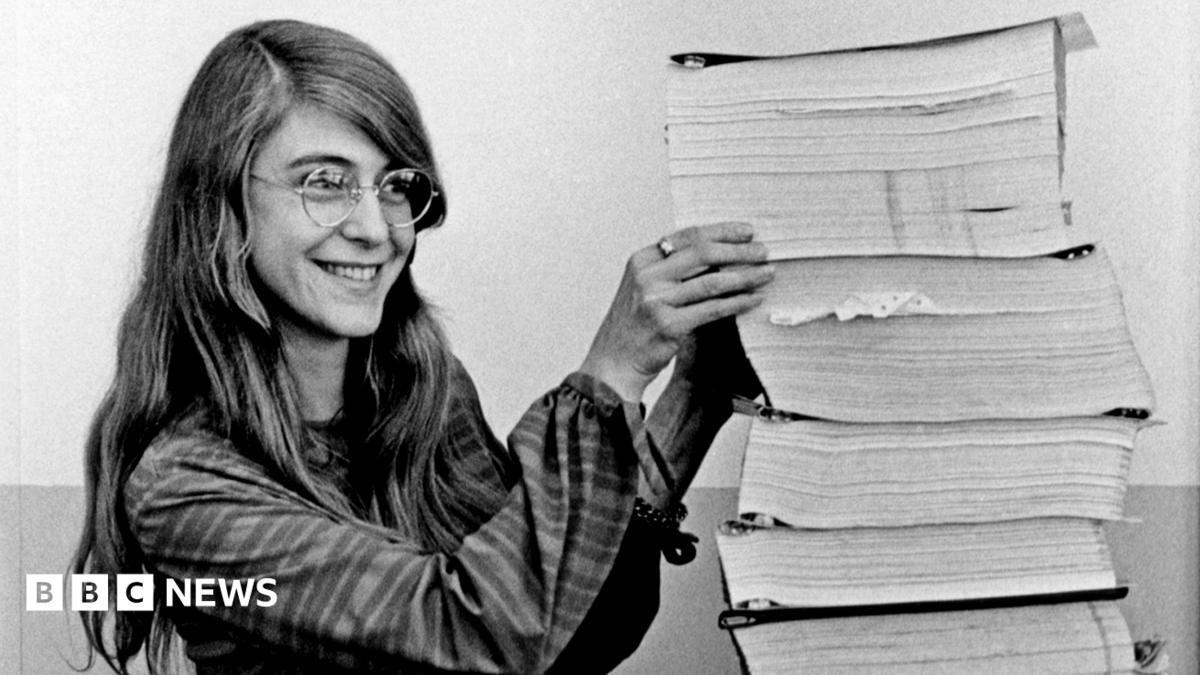
Margaret Hamilton, the computer scientist whose pioneering work in software development helped guide Nasa's Apollo 11 astronauts to the first successful Moon landing, has died at the age of 90. Her former employer, the Massachusetts Institute of Technology (MIT), confirmed her passing and noted that she died on 30 September. The loss of Hamilton marks the end of a life that not only altered the course of space exploration, but also reshaped an entire profession that, at the time of her work, was still in its infancy.
Hamilton's contributions to Nasa's missions have long been regarded as some of the most crucial behind-the-scenes efforts in the history of space travel. As the leader of the Software Engineering Division at MIT, she was responsible for writing and testing all of the onboard in-flight software for the Apollo 11 project. This software was what ultimately guided US astronauts Neil Armstrong and Buzz Aldrin to land safely on the Moon in 1969. Without it, the unprecedented feat of placing humans on another celestial body would have been far more perilous, with little room for error in the final moments of descent.
The scale of Hamilton's influence can be measured not just by the mission's success, but by the language that came from her work. It was during her time with Nasa's Apollo programme that the term "software engineering" was first coined. At a point in history when programming was often dismissed as an auxiliary task, Hamilton's insistence on treating it with the same rigour and discipline as traditional engineering helped establish it as a legitimate field. As MIT noted in its statement, to describe Hamilton as a pioneer or ahead of her time would be a dramatic understatement. She was, in many ways, helping to define the profession before it was widely recognised.
This trailblazing path was one that Hamilton actively sought out. Speaking to the Guardian in 2019, she recalled her motivations for joining the Apollo project, stating that she was attracted both by the sheer idea of it and by the fact that it had never been done before. She would go on to become the first programmer to join MIT's Apollo team, and the first woman that the team hired. These milestones would set the tone for a career spent breaking into spaces that had rarely, if ever, welcomed women in technical roles at that level.
Hamilton's entry into the field was also shaped by practical circumstances. Born in Indiana in 1936, she first studied mathematics at the University of Michigan in 1955, before moving to Earlham College, where she earned a BA in mathematics in 1958. A year later, she relocated to Boston, Massachusetts, with her husband and took a job at MIT to support him while he pursued his law degree. What began as a means of support soon evolved into a lifelong pursuit, as Hamilton began working at MIT in 1959 and would remain there until the mid-1970s, eventually managing its Software Engineering Division.
The most famous test of Hamilton's work came in the final moments of Apollo 11's descent to the lunar surface. With Armstrong and Aldrin nearing the Moon, an onboard computer raised an alarm, detecting that it was becoming overloaded. For a moment, the success of the landing hung in the balance. However, Hamilton and her team had foreseen the possibility of such an issue and engineered "priority-driven software" that would shut down non-essential background tasks and prioritise the landing itself. This safeguard allowed the mission to proceed, cementing its place as one of the greatest technological achievements of the 20th century.
That split-second decision showcased the value of preventative engineering. Rather than assuming a system would run flawlessly, Hamilton's team accounted for failure and built redundancy into the software. It was an approach that would go on to influence safety-critical computing for decades to come, from spacecraft and aviation systems to the complex, fault-tolerant technologies relied upon today. The Apollo 11 alarm has since become a textbook example of the importance of robust software design.
The scale of the effort behind that moment was also immortalised in one of the programme's most recognisable images. In 1969, a photograph captured Hamilton standing beside a towering stack of printed Apollo guidance computer code, a visual representation of the immense labour her team had poured into the mission. The image has since become emblematic of the unsung work that underpinned the Moon landing, often shared to highlight the role of women in technology and the sheer magnitude of early computing.
These contributions would only be fully recognised on a national scale decades later. In 2016, then President Barack Obama awarded Hamilton the Presidential Medal of Freedom, the highest civilian honour in the United States, for her contributions to science and space travel. At the ceremony, Obama noted that Hamilton "symbolises that generation of unsung women who helped send humankind into space". The award served as a long-overdue acknowledgement of her impact, bringing her work to a wider audience outside of the computing and aerospace fields.
Following her time at MIT, Hamilton continued to apply her expertise in the private sector. From the 1970s onwards, she founded her own software businesses, including Hamilton Technologies, which remains based in Massachusetts to this day. Her work extended beyond Apollo, drawing from her experience in software reliability to develop tools and approaches for other complex systems. In doing so, she continued to champion the engineering principles that she had pioneered, ensuring they could be applied to future generations of technology.
Hamilton's legacy has also been felt by the institutions that shaped her early life. Earlham College, where she obtained her mathematics degree, paid tribute to her following her death, describing her pioneering spirit and remarkable legacy as something that would continue to inspire generations of Earlhamites. The college's statement reflected the reach of her influence, noting that she was not only an alumna of distinction, but a figure whose accomplishments opened doors for those who would follow in her footsteps.
The human cost of her loss is felt by those closest to her. According to MIT, Hamilton is survived by her daughter, a son-in-law, two grandsons and four great-grandchildren. While her professional achievements have been etched into history, her passing is also a deeply personal one for her family, who now carry her memory alongside the global recognition of her work.
As the world reflects on her life, Hamilton's story holds lasting implications for the fields of science, technology and history. Her insistence on discipline in software, her foresight in building for failure and her determination to enter uncharted territory helped make the Moon landing possible. More broadly, she helped legitimise an entire profession, creating space for future generations of engineers in the process.
Decades on from the moment Armstrong set foot on the lunar surface, the code that made that landing possible is often remembered through Hamilton's name. Her death at 90 may mark the end of her life, but the standards that she set, the barrier she broke and the mission she helped secure will continue to echo through space exploration and software engineering for many years to come.






(0)