
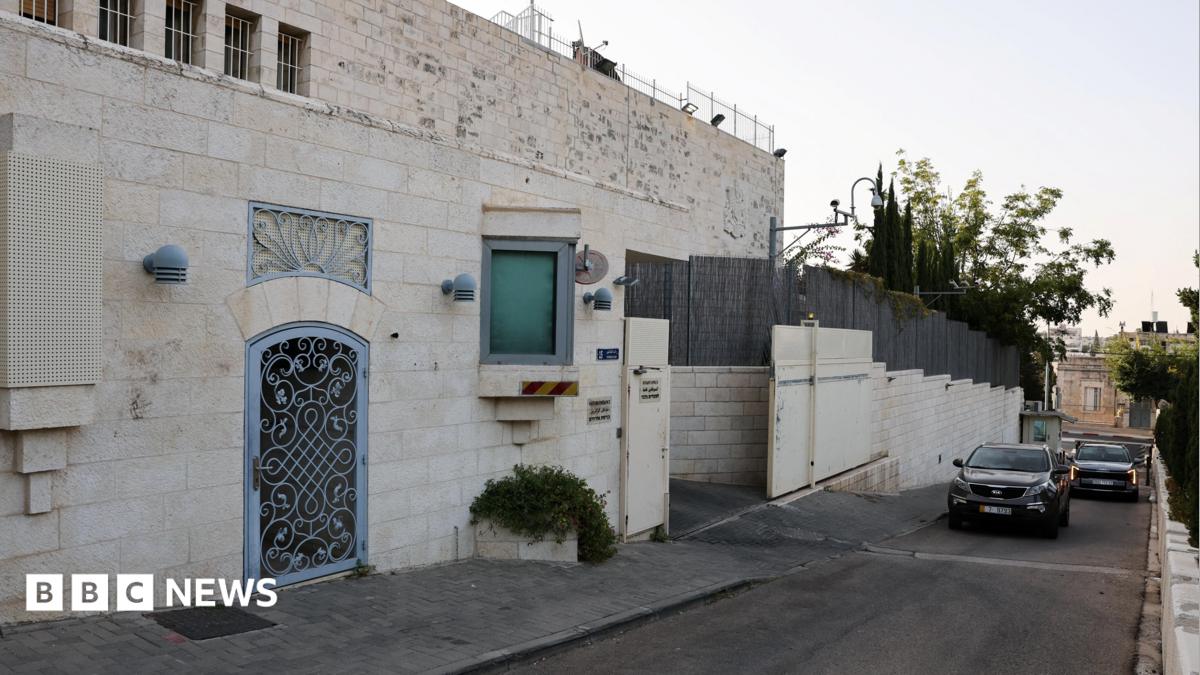
Most of Britain's diplomatic staff are to vacate the British consulate in occupied East Jerusalem, Israel announced on Thursday, in a move that marks one of the sharpest strains in Anglo-Israeli relations in recent years. The Israeli foreign minister, Gideon Saar, said the consul general and 20 diplomats would end their duties and depart Israel, while a far smaller group would remain behind under tightly constrained conditions. The UK, however, has rejected the premise that the post is being shut down at all, insisting instead that the building "will not be closing" and will carry on operating under a new name: the UK Mission, Jerusalem.
Writing on social media, Saar struck a sombre tone, declaring: "We did not want it to come to this." He said Israel had carried out the measures first unveiled on 8 September, confirming that the sign identifying the premises as the British Consulate had been taken down. Yet the picture on the ground appeared more ambiguous than the statement suggested: the British flag was still visible outside the building, and several staff members were observed arriving on Thursday morning as the deadline arrived.
The Israeli foreign minister also disclosed that negotiations with London had produced agreement on a set of principles governing the drawdown. Under those terms, the consul general and 20 diplomats will leave Israel entirely. Crucially, Saar acknowledged that the building itself remains "the property of the British government" — a point that has become central to the dispute — and said Israel had authorised a "task force of only seven diplomats with a very limited scope of activity" to continue working inside. He added that, as a result of the understanding reached with the UK, "no steps will be taken against Israel."
For its part, the British government has framed the episode very differently. In a written statement issued on the morning of the deadline, Foreign Secretary Ed Miliband said London does not accept that Israel has the right to close the consulate in the first place. "The UK government reiterates its long-standing view that East Jerusalem is occupied territory," he said, restating a position that has underpinned British policy for decades and that lies at the heart of the entire confrontation.
Miliband confirmed that, following discussions with the Israeli government, the premises would continue to function as the UK Mission, Jerusalem from Thursday onwards. However, he conceded that no understanding had been reached on what he described as "necessary assurances for the security and protections of our staff and premises." Accordingly, he said, the UK had "temporarily withdrawn a number of staff and families to ensure their safety and security." Speaking separately, Miliband stressed that some personnel had been pulled out for security reasons, but that the mission would continue to "work with the Palestinian people."
The immediate trigger for the crisis dates back to September, when Israel said it would shutter the British consulate in retaliation for UK sanctions imposed on Israeli settlements in the occupied West Bank. Those settlements are regarded as illegal under international law, a stance the UK has repeatedly emphasised. Israel had given itself a 30-day window from the announcement of the sanctions to close the post, and Thursday marked the expiry of that deadline. In the days beforehand, the UK government mounted last-ditch efforts to persuade Jerusalem to change course, though those appeals ultimately proved unsuccessful.
The consulate carries considerable historical and practical weight. First established in 1838, it serves as the primary channel through which Britain conducts its relations with Palestinians in Jerusalem, as well as in the West Bank and the Gaza Strip. Its function is entirely separate from the UK embassy in Tel Aviv, which remains the principal diplomatic hub for dealings with the Israeli government. That division of labour explains why the dispute has such disproportionate symbolic significance: the East Jerusalem post is one of the few remaining institutions through which a Western power formally engages with Palestinian affairs from within the city itself.
Both capitals appear keen to claim the outcome as a form of agreement, though the two accounts diverge sharply in emphasis. Saar portrayed the arrangement as an Israeli-imposed closure accepted by London, with a rump team allowed to remain only at Israel's discretion. Miliband, by contrast, cast it as proof that the building would remain open under British sovereignty, with withdrawals driven by unresolved security concerns rather than by any Israeli right to expel diplomats. This gap between the two narratives is likely to complicate any attempt to repair the relationship.
The scope of the departure nonetheless signals a significant downgrade in practice, whatever the language used on either side. Reducing a diplomatic post that has operated for nearly two centuries to a seven-person task force with, in Israel's own words, "a very limited scope of activity" inevitably curtails the capacity to deliver consular services, monitor developments, and sustain the relationships the mission was designed to maintain. For Palestinians in Jerusalem, the West Bank and Gaza who have relied on the post as a point of contact with the British government, the practical consequences could be felt long before any political resolution is reached.
Reporting in the Israeli press had suggested the confrontation might escalate further, with claims that the UK had threatened to expel Israeli diplomats from London. Such a step, had it materialised, would have risked plunging bilateral relations into even deeper trouble. The agreement apparently reached between the two governments appears to have averted that scenario for now, but the underlying sources of friction — sanctions on settlements, the status of East Jerusalem, and the future of the diplomatic post itself — remain unresolved.
Analysts watching the dispute note that the episode has exposed how quickly procedural arguments can harden into sovereignty questions. Israel's insistence on removing the consulate's sign and limiting staffing sits alongside Britain's refusal to concede any Israeli authority over the premises, leaving both sides locked in a dispute over symbols as much as over personnel. The renaming of the building as a "UK Mission" is a compromise in form, but it has satisfied neither capital in substance.
Looking ahead, the temporary nature of the British withdrawals, as described by Miliband, leaves open the possibility of a return to normal staffing if security assurances can be secured. Yet no timeline has been offered, and the absence of agreement on protections for staff and premises suggests those discussions could be protracted. For now, the Union Jack still flies over a building whose future status remains contested — and whose dwindling complement of diplomats has become a barometer of one of the world's most enduring conflicts.






(0)