
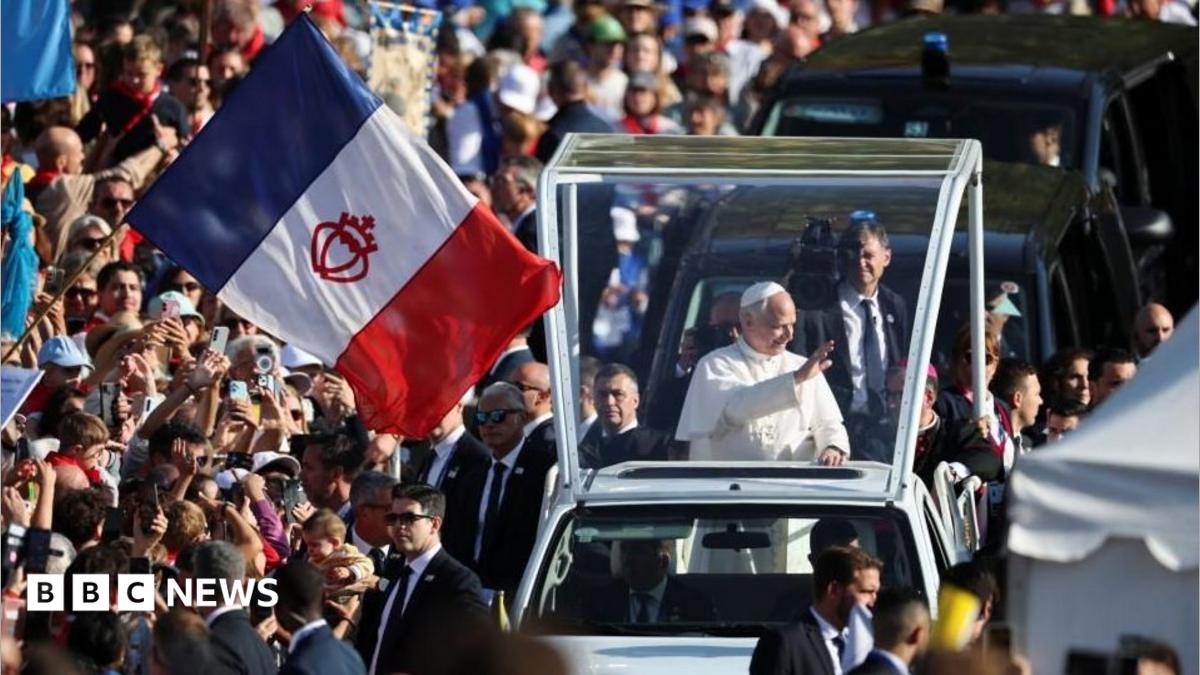
Pope Leo XIV has told French bishops that the sexual abuse of minors must be rooted out of Catholic life in the country, urging them to sustain "the greatest vigilance" as they continue a process of reckoning with decades of clerical and institutional failure. The pontiff delivered the appeal during a private meeting with senior church leaders at the Sanctuary of Our Lady of Lourdes in southern France, the third day of his first official trip to the country since being elected leader of the Roman Catholic Church in May 2025.
The assembly took place behind closed doors, with the text of the Pope's remarks released to reporters afterwards. In it, he praised the determination French bishops have shown in confronting what he described as the "painful scourge of abuse of minors committed by members of the clergy or within an ecclesial context" — a formulation that acknowledges abuse by both ordained figures and lay members of the Church. He told those present that the Church must "persevere along the path" they had begun.
The warning carries particular weight in a country where the scale of the abuse has been formally documented. A 2021 inquiry concluded that clergy or lay members of the Catholic Church had abused roughly 330,000 people as children in France over a period of about seven decades. That figure, drawn from investigations into dozens of dioceses, remains one of the largest tallies of institutional child abuse anywhere in Europe and has permanently altered the relationship between the French Church and the state, the public and many of its own faithful.
The Pope's intervention came shortly before what observers consider the most emotionally charged element of the visit: a private meeting with survivors of abuse, scheduled for later on the day at Lourdes. Survivors' organisations have long pressed the Vatican for direct engagement with those who suffered under Church cover, and the meeting places the abuse crisis at the centre of an otherwise largely pastoral and celebratory visit. Hundreds of thousands of people have gathered in the sanctuary town to hear him speak, with many camping overnight and filling the esplanade around the shrine.
The scale of welcome extended well beyond Lourdes. The day before, an estimated 700,000 people packed the Place de la Concorde in Paris to hear the pontiff address the nation, while huge crowds cheered and waved as he travelled down the Champs-Élysées in an open-topped popemobile. Earlier in the week, the Pope met French President Emmanuel Macron, a courtesy that underlined the diplomatic weight attached to a visit by a head of state to a nation with an avowedly secular modern political history but deep Catholic roots.
Away from the abuse agenda, the Pope used Saturday's Mass in Paris to make a pointed appeal about religious engagement. He told worshippers that Catholics should not hold their faith in private but should let it "overflow", so that those they encounter may be refreshed by it. He also addressed young people directly, describing them as "today's Church" and telling them of the "enthusiasm, energy and commitment, and the joy" they bring to Christian communities — language read by observers as a deliberate attempt to speak to a generation that has largely grown up outside parish life.
The numbers behind that challenge are stark. Regular Mass attendance in France has fallen from about 35% of the population in 1960 to less than 5% today, while the number of priests has shrunk by two-thirds, from some 25,000 in 1990 to fewer than 9,000. Vocations, parish closures and secularisation have combined to reshape the Church's institutional footprint within a single generation, at the same moment as the abuse crisis has demanded the attention and credibility of exactly those structures.
Against that backdrop, the Pope pointed to signs of renewed interest in religious tradition. The number of adult baptisms has more than doubled in five years, reaching 10,000 in 2025 — a modest figure beside France's population, but one that suggests a growing number of adults are turning to the Church for the first time, or returning to it, in a period marked by searches for community, ritual and meaning.
The visit has also touched on issues beyond Catholicism. In a separate address, the Pope warned against the risk of society "losing humanity" through its reliance on artificial intelligence, a theme consistent with his wider insistence on the ethical responsibilities of technology. It signals an attempt, during a heavily symbolic trip, to present a papacy with a broad social agenda rather than a purely internal focus on the Church's own failings.
On Sunday, the Pope is due to visit staff and residents at a health facility at Lourdes before joining an evening torchlight procession, a traditional element of the sanctuary's pilgrim calendar. Then comes the meeting with abuse survivors, for which many campaigners have pressed for concrete outcomes — including canonical and civil investigations, compensation and institutional reform — rather than words alone.
Whether the appeal lands is a question of credibility as much as conviction. The Pope's language of vigilance echoes commitments made by his predecessors, and survivors' groups have repeatedly warned that expressions of regret without structural change amount to little. His first visit to France therefore carries a double burden: to demonstrate that the Church can speak with renewed moral authority to a largely secular society, and to show that it is willing to confront the worst episodes in its own recent history in the presence of those who endured them.





(0)