
Twenty-seven people are dead following two mass shootings that took place only hours apart in South Africa, according to police, in what is the latest spasm of gun violence to strike the country of roughly 62 million people. The attacks in Johannesburg and Cape Town are separate incidents, but occurring in the same weekend they underscore a pattern officials have struggled to stem for more than two decades.
The first attack unfolded on Saturday evening near Johannesburg, where eight gunmen stormed a bar, opened fire on customers gathered outside, then carried the assault inside. As they fled the scene, the attackers set fire to two vehicles. Seventeen people were killed in the attack and a further 15 were injured, police said. The death toll included 13 men and four women, and authorities said the motive remained unclear.
The second shooting came in the early hours of Sunday morning, when gunmen opened fire outside an entertainment venue in a township near Cape Town. Ten people were killed and 11 others were wounded. Five victims died at the scene, while five more succumbed to their injuries in hospital — a detail that emergency services often cite when discussing the strain such attacks place on local medical response capacity.
No arrests had been made in either case as of Sunday morning, and police have not indicated a motive for either attack. That absence of information has been a source of growing public frustration, particularly because it leaves investigators without a clear line of inquiry into who the perpetrators are or what dispute may lie behind them. The Johannesburg death toll of 17, the single deadliest of the two, is already among the country's worst mass killings in recent memory.
The weekend's violence came only days after 11 people were killed in Durban, where gunmen stormed a house in the KwaMakhutha township. Three such incidents in the span of little more than a week have pushed the country's body count sharply upward and revived fears that a recent spate of mass shootings signals a deepening of a long-running crisis rather than a series of isolated tragedies.
For context, South Africa has one of the highest murder rates in the world. Official figures put the daily average at around 60 murders, a statistic that has become almost shorthand for the scale of the problem. Illegal firearms circulate widely, and analysts have repeatedly linked surges in lethal violence to turf wars between gangs competing over drug trafficking routes and illegal mining operations — both of which reward armed groups for their firepower.
President Cyril Ramaphosa has acknowledged the scale of the threat. In February, he described organised crime as "the most immediate threat to our democracy, our society and our economic development", a formulation that frames the violence not merely as a law-and-order issue but as something that strikes at the country's economic prospects and democratic institutions. Cabinet ministers have used similarly stark language in recent months.
The government has also responded with measures outside the normal policing framework. Earlier this year, the military was deployed alongside police in areas recording the highest murder rates, an unusual step intended to supplement stretched police capacity and get more armed personnel into areas where gang violence has become entrenched.
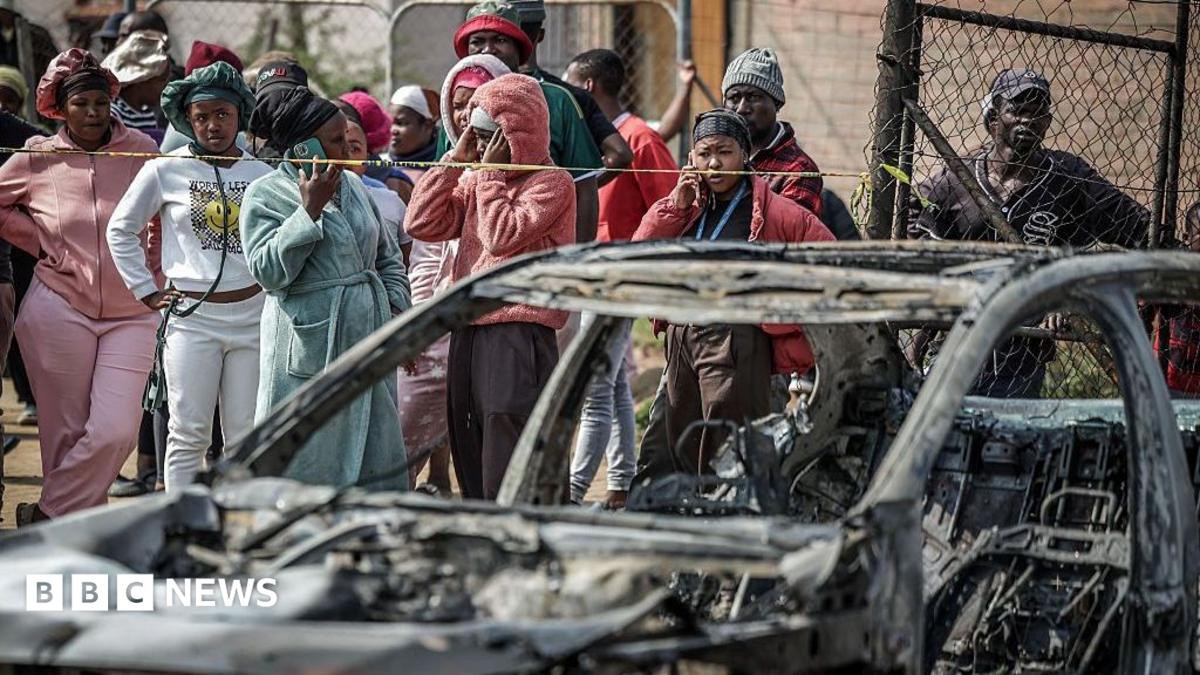
Armed security forces were deployed to the Cape Town scene on Sunday morning, with armed guards patrolling roads near cordoned-off areas as residents looked on from behind police tape. Images from Johannesburg showed onlookers gathered near a burned-out car, one of the vehicles the gunmen set alight as they escaped.
Investigators will face a difficult task. Mass shootings of this kind, in which small groups of heavily armed men inflict rapid casualties in crowded public settings, often prove exceptionally hard to solve, particularly where the weapons used are illegally sourced and untraceable. Police have not said whether the two weekend attacks are being treated as connected, and no evidence linking them has been published.
Attention now turns to whether the killings of 11 in Durban, 17 near Johannesburg and 10 near Cape Town will prompt further state intervention. Police investigations into a separate series of killings are already continuing, with the body of a tenth woman reportedly recovered as detectives probe what authorities have described as a spree of murders.
What is clear is that the response so far has not prevented the next attack. With murders running at about 60 a day and mass shootings now arriving in clusters rather than isolated incidents, South Africa's leaders face growing pressure to treat gun violence as a national security question — one that, in the words of the president, threatens the country's democracy and its economic development at the same time.
For the families of the 27 victims, the questions of motive and accountability remain open. The investigations have barely begun, and with no arrests reported and no explanation offered by police, the weekend's twin tragedies are likely to be remembered less as a solved case than as a marker of a country still searching for a way to stem a decades-long tide of lethal violence.




(0)