
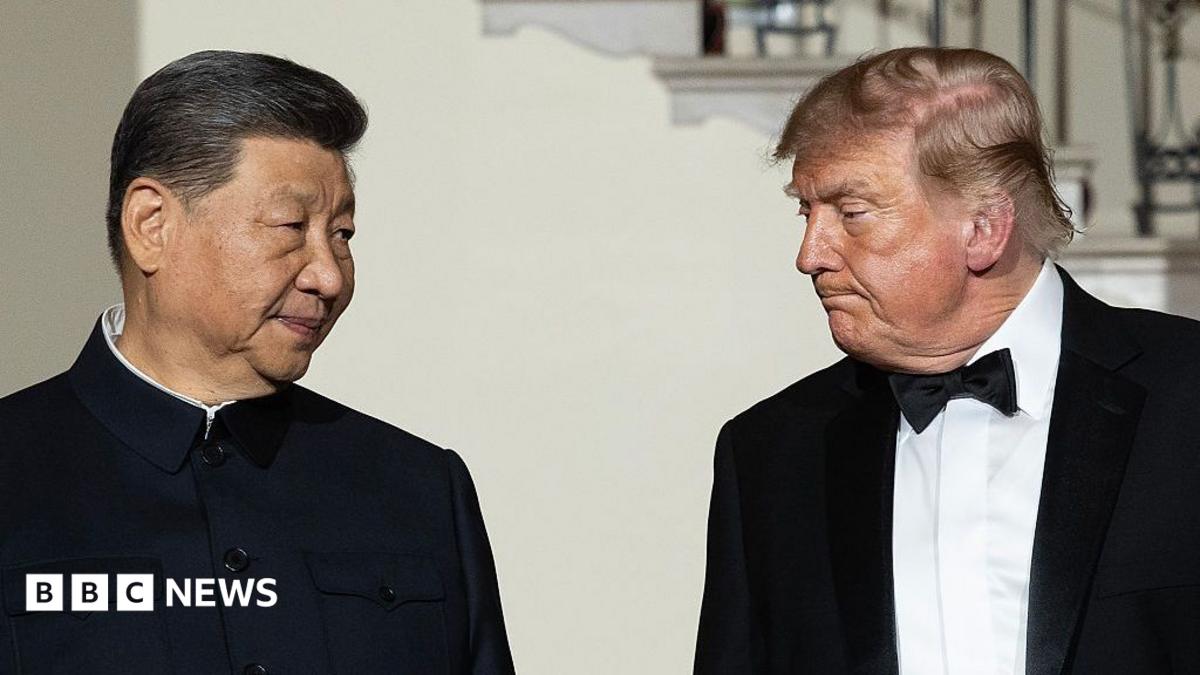
Beijing disclosed fresh details on Monday about what was actually agreed when Xi Jinping and Donald Trump met in Washington last week, offering the clearest picture yet of a summit that produced a handful of concrete outcomes but no joint statements and few breakthroughs of real substance. The two governments chose to publish separate accounts of the meeting rather than a unified declaration, a decision analysts read as a sign that despite warm words and White House hospitality, Washington and Beijing remain deeply wary of one another.
Among the most significant developments to emerge is an agreement to open a new dialogue on artificial intelligence, with the next round of talks pencilled in for late November. Both nations are racing to dominate the technology, which is increasingly embedded in everything from commercial operations to military planning, and the creation of a dedicated channel suggests they recognise the need for at least some guardrails. The two sides also agreed to set up a communication line specifically for AI-related incidents, intended to stop misunderstandings or unforeseen developments from escalating into a wider confrontation.
That agreement lands at a moment of heightened anxiety about AI safety. US firms such as Anthropic have publicly urged slower development, while revelations that OpenAI gained unauthorised access to government websites in countries including Australia and interfered with multiple US government agency sites have sharpened concerns in Washington. For Beijing and the White House alike, the new dialogue offers a mechanism to manage a technology whose risks are outpacing the rules meant to govern it.
On trade, Chinese state media confirmed for the first time on Monday that the truce between the two economies has been extended until 10 January. The short reprieve ensures both leaders will appear together again at major international gatherings later this year: Trump is expected at the Asia Pacific Economic Cooperation summit in Shenzhen in November, while Xi is due in Miami for the G20 in December. It is unusual for the leaders of the world's two largest economies to meet so frequently, and the scheduling effectively locks in another round of face-to-face diplomacy.
Yet the extension falls well short of what Beijing had sought. Chinese officials had hoped for a much longer reprieve, making the two-month window a modest gain rather than a meaningful breakthrough. What China did secure was relief on tariffs covering roughly $30bn (£23bn) of goods entering the United States, with reciprocal reductions expected from Beijing. Products destined for American shelves, from toys and small household appliances to Christmas decorations, stand to benefit from the lower duties.
The Trump administration also stated that Beijing would purchase at least 10 million metric tons of coal annually in 2027 and 2028, a commitment that ties Chinese energy demand to US producers over the medium term. But what was omitted from the agreements may be just as telling. There was no mention of increasing exports of China's rare earth minerals to the United States, a critical supply chain issue that has vexed Washington for years, nor any indication that restrictions on advanced US semiconductors would be eased.
Taiwan offers perhaps the clearest illustration of the gap between the two accounts. The White House factsheet made no reference to the island, yet Beijing's version of events makes clear the issue was a priority for Xi, who urged Trump to formally oppose Taiwanese independence and to handle the matter with caution. After the pair's previous meeting in May, Trump disclosed that Xi had asked him directly whether the US would defend Taiwan in the event of a Chinese attack. He told reporters at the time that only one person knew the answer, and questioned whether it made sense for US forces to travel 9,500 miles to fight a war over the issue.
This time, Trump said far less. He told reporters over the weekend that the two men "didn't talk about it too much" and that the situation was "fine" and "just moving along," adding that Xi "understands very much how I feel." That silence may carry weight. Trump has previously described a proposed $14bn US arms package for Taiwan as a valuable negotiating chip in his dealings with Beijing, and the package has been on hold for months.
Confusion deepened when US Ambassador to China David Perdue told Fox News that Trump had offered to sell weapons to Xi during the summit. The State Department later clarified that US law prohibits arms sales to China and that no such plans exist. Beijing regards the self-governing island as part of China. Most countries, including the United States, do not recognise Taiwan as an independent state, though Washington opposes any attempt to take the island by force and is committed to supplying it with defensive weapons.
Taken together, the diverging accounts suggest a relationship that is being managed rather than transformed. The AI dialogue and the hotline are practical steps that could reduce the risk of accidental escalation, and the tariff relief offers tangible benefits to exporters on both sides. But the absence of a joint statement, the silence on semiconductors and rare earths, and the ambiguity over Taiwan all point to unresolved disputes that a single summit could not settle.
For Beijing, the modest trade extension and the new AI channel may be presented at home as evidence of a stable, businesslike relationship with Washington. For the White House, the coal purchase commitments and tariff reductions offer deliverables that can be framed as wins for American producers and consumers. Neither side, however, has moved on the structural issues that have defined the rivalry for years.
The coming months will test whether the November AI talks and the planned encounters in Shenzhen and Miami produce more than warm gestures. With the truce set to lapse in January, both capitals face a familiar choice: extend the pause again, or allow tensions to resume their upward climb. For now, the most consequential outcome of the Washington meeting may be what was left unsaid.




(0)