
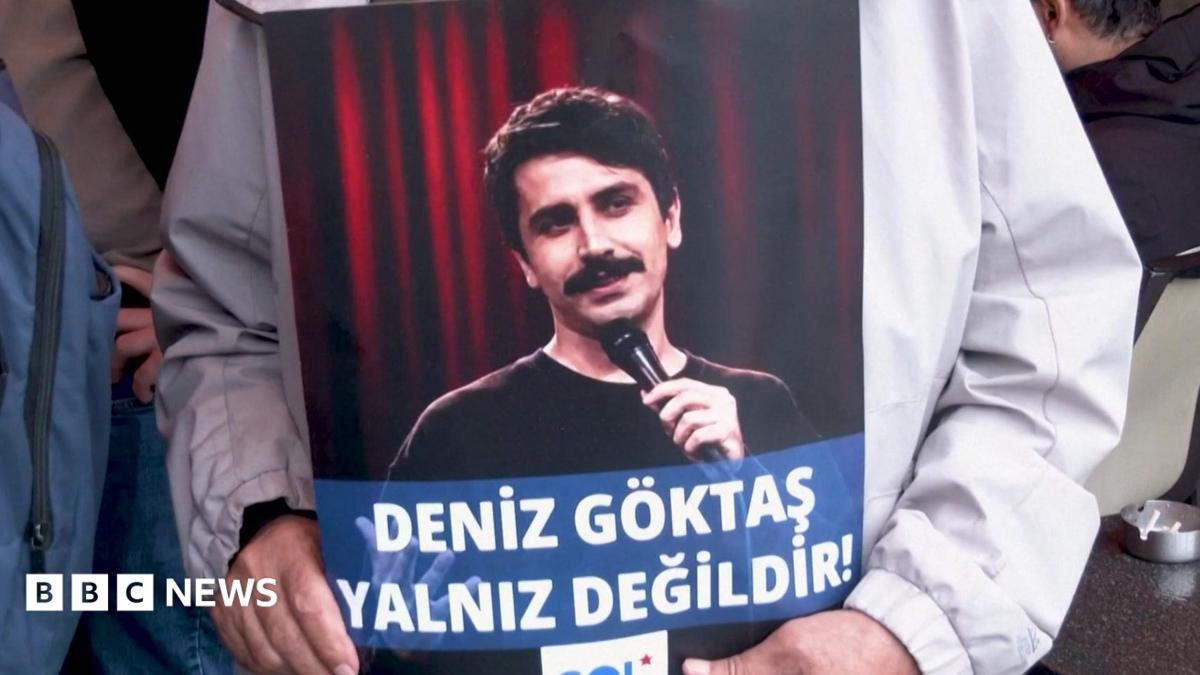
An Istanbul court has found popular stand-up comedian Deniz Göktaş guilty of insulting Turkish President Recep Tayyip Erdoğan, sentencing him to nearly 19 months in prison but ordering his release because of time already spent behind bars. The court also imposed a travel ban, barring him from leaving Turkey, and a final ruling in the case will rest with the court of appeals.
The verdict, delivered on Monday, caught many of the comedian's supporters by surprise. Göktaş had been detained since July, when he was arrested and handcuffed at Istanbul airport upon returning from a holiday. He has already served close to 90 days in prison, including 88 days in solitary confinement, according to the account given in court.
Prosecutors had sought a far heavier punishment. They asked the court to sentence Göktaş to up to 12 years in prison, a demand that underscored the severity with which Turkish authorities have treated his on-stage remarks. Instead, the panel handed down a sentence of almost 19 months and credited the time he had already served, clearing the way for his release.
The case centered on a line from a stand-up routine that became a viral sensation on YouTube, drawing more than 15 million views. In that performance, Göktaş described the Turkish leader as a "shy dictator." Prosecutors singled out that remark as the basis for the insult charge, arguing it crossed the line from comedy into criminal defamation.
Göktaş rejected that characterization throughout the proceedings. He maintained that there was "no criminal element" in his comments and offered a pointed defense of his word choice. "Dictator is not an insult," he told the court, according to the source account. "It is a political characterisation." That argument reflects a long-running debate in Turkey over where satire ends and insult begins, particularly when the target is the head of state.
During his appearance on Monday, the comedian demonstrated that nearly three months in detention had not dulled his comic instincts. "Three months have been taken away from my life," he said from the stand. "But I quit smoking, so I'll add another three months to my life." The remark drew laughter and loud applause inside the courtroom, a rare moment of levity in a proceeding that had been watched closely by rights advocates.
Outside the courthouse, supporters had gathered with signs that translated to "Deniz Göktaş is not alone," according to the source report. Among them was Firat Aksal, a fellow comedian, who described the outcome as a welcome shock. "We hardly know what to do with our happiness," he said. "We are thrilled. To be honest, we weren't hopeful of getting a fair trial." Aksal added that Göktaş planned to rest for a few days and see his family before returning to the stage.
The comic was expected to be released within hours of the ruling. Yet the travel ban means his freedom will remain qualified, at least until the appeals process concludes. The case has become a focal point for broader concerns about free expression in Turkey, where human rights organizations say a wave of arrests is aimed at crushing dissent.
Those warnings extend well beyond the world of comedy. According to the source report, Turkish prisons currently hold a wide range of detainees, including journalists, human rights campaigners, student protesters, LGBTQ activists, and the elected Mayor of Istanbul, Ekrem Imamoglu. The breadth of that list has fueled criticism that the justice system is being used to silence political opposition and civil society at large.
For Turkey's stand-up scene, the Göktaş affair has highlighted the risks that come with addressing sensitive subjects on stage. Comedy has long served as a vehicle for political commentary, but the line between satire and criminal insult has become increasingly hazardous when the president is the subject. The threat of lengthy prison terms, advocates argue, can have a chilling effect that extends far beyond any single performer.
The source article notes that a previous BBC report documented Göktaş's detention in connection with jokes about Erdoğan and Islam, describing it as part of a broader crackdown. That earlier coverage, published in early July, framed his arrest as one in a series of measures targeting voices critical of the government.
The appeal stage now looms as the next significant legal battle. Until the court of appeals issues a final decision, the conviction and the accompanying travel restriction remain in place. The outcome will be closely watched both in Turkey and abroad as a gauge of how far the judiciary is willing to go in cases involving insults to the head of state.
For his supporters, Monday's ruling represented a partial victory: Göktaş will leave prison, but he will not leave the country, and the conviction remains on his record. For critics of the government, the case stands as another illustration of the pressure facing dissent in Turkey, even as a comedian known for his sharp wit prepares to return to the stage.





(0)