
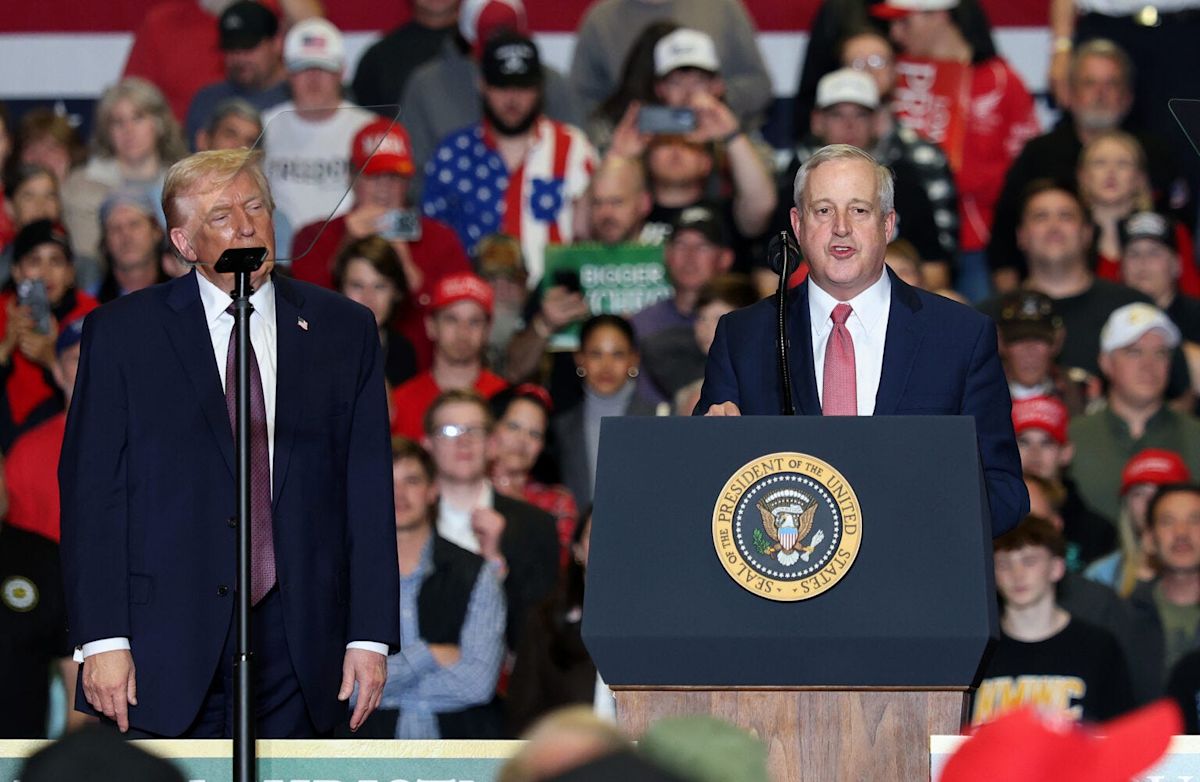
President Donald Trump is scheduled to travel to North Carolina on Wednesday to campaign alongside Republican U.S. Senate nominee Michael Whatley. The high-profile appearance in the battleground state comes as Republican strategists display growing concern over their prospects in what has become one of the most closely watched Senate contests in the country.
Whatley, who previously served as chairman of both the Republican National Committee and the North Carolina Republican Party, is currently locked in a challenging contest against Democratic nominee Roy Cooper. Recent polling and fundraising disclosures indicate that Whatley continues to trail Cooper, the state’s former two-term governor, prompting national party figures to invest extra energy into shoring up the GOP ticket.
The North Carolina contest is regarded as a pivotal piece in determining the balance of power in the upper chamber of Congress. The seat is becoming open due to the upcoming retirement of Republican U.S. Sen. Thom Tillis. Nonpartisan election forecaster Cook Political Report currently classifies the general election matchup as "lean Democrat."
At present, the Republican Party holds a 53-seat majority in the U.S. Senate, compared to 45 seats held by Democrats and two seats held by independents who caucus with the Democratic minority. Because the margins remain narrow, any loss of an incumbent-held seat could have far-reaching ramifications for legislative control on Capitol Hill.
Whatley publicly welcomed the news of the upcoming campaign stop, sharing his excitement on social media about hosting Trump in his hometown of Gastonia. The Republican candidate stressed that Trump requires dependable allies in Washington and asserted that North Carolina voters desire a fighter in the Senate, expressing confidence in a general election victory on November 3.
The fight for North Carolina is playing out alongside a demanding national map for Republicans. Beyond the Tar Heel State, the party is working to defend competitive open seats in Texas and Iowa—territories that historically did not require substantial defensive spending—while simultaneously protecting incumbents in Ohio, Maine, and Alaska. At the same time, the GOP is attempting to flip Democratic-held seats in Georgia, New Hampshire, and Michigan.
Compounding the challenge in North Carolina is the immense cost of advertising across the state's dominant media markets, including the Charlotte and Raleigh-Durham metropolitan areas. With television and digital ad rates placing heavy demands on campaign coffers, party leaders in both organizations may be forced to make difficult budgetary decisions and triage their available financial resources across the country.
Eric Heberlig, a political science professor at the University of North Carolina at Charlotte, noted that national Republicans are carefully evaluating their broader defensive options. He pointed out that the GOP could theoretically retain its majority in the Senate even in the event of a defeat in North Carolina, which factors into strategic calculations regarding where to spend funds to mitigate overall losses.
Heberlig emphasized that a personal visit from a sitting president underscores just how vital the Senate seat is viewed from a national perspective. However, with Trump’s public approval rating in North Carolina standing at approximately 35%, the Gastonia rally is not expected to persuade large numbers of undecided or moderate swing voters.
Instead, the primary objective of the Gastonia event is to energize the conservative base. Political analysts observe that the appearance is designed to turn out low-propensity voters who might otherwise skip a midterm election or who are not yet well acquainted with Whatley's individual candidacy.
According to Heberlig, the strategic imperative for the Republican campaign centers on retaining those who previously supported Trump as well as Republican senators Thom Tillis and Ted Budd. The goal of the visit is to ensure those past GOP voters return to the ballot box and consistently vote for the Republican ticket.
The rally in Gastonia could also generate beneficial down-ballot momentum in western North Carolina, where the party is navigating a competitive contest in the 11th Congressional District following political controversy. The state Republican Party selected state Rep. Jennifer Balkcom to replace former representative Edwards on the ballot in that race.
Balkcom is slated to compete against Democratic candidate Jamie Ager, a fourth-generation farmer representing a well-known political family, in a district that Cook Political Report currently rates as "lean Republican." Mobilizing strong conservative turnout in nearby regions could play an important role in securing the congressional seat.
While Democrats in North Carolina have captured significant victories in state-level elections in recent cycles, replicating that success in federal races has historically proven difficult. North Carolina voters have not chosen a Democratic U.S. senator or backed a Democratic presidential contender since 2008, when Barack Obama won the state.
Despite that historical hurdle for Democrats, Cooper enters the race with significant advantages in visibility and statewide appeal. Having completed two terms as governor and four consecutive terms spanning 16 years as state attorney general—the longest tenure in state history—Cooper possesses a well-established political brand. Heberlig observed that Cooper’s repeated statewide victories and strong name recognition provide him with a solid electoral foundation.
Cooper launched his general election campaign earlier this year in Raleigh with a platform focused heavily on kitchen-table economics, pledging to implement policies aimed at lowering grocery and everyday food costs for families. Meanwhile, Democrats argue that Trump's visit, combined with Whatley recently receiving a prominent speaking slot at the GOP midterm convention in Dallas, signals growing unease within the Republican Party about holding the seat.




(0)