
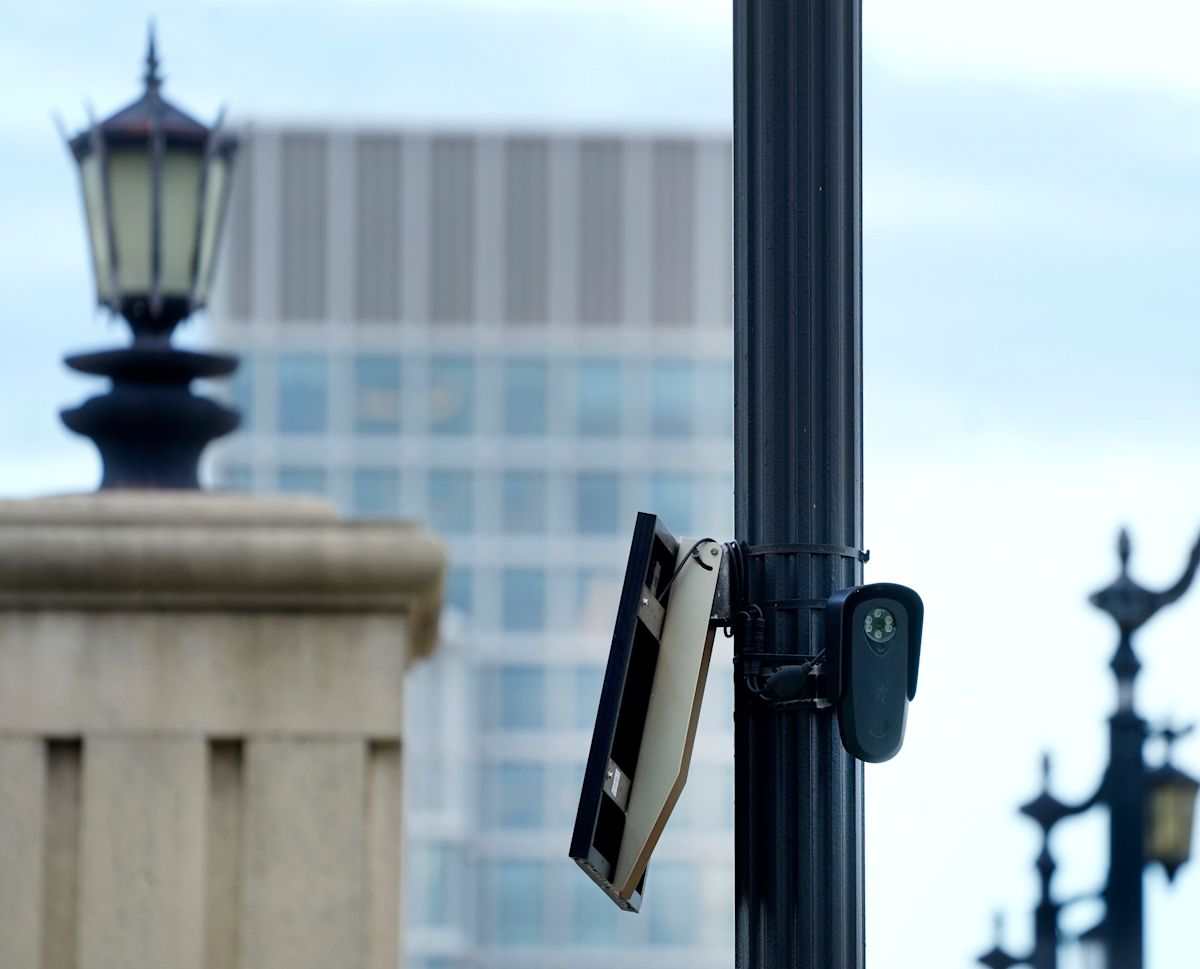
A recent state-level regulatory directive has sparked renewed discussions surrounding law enforcement surveillance, privacy rights, and the rapid expansion of automated license plate reader technology across Alachua County. The shift follows an abrupt move by state transportation officials that requires local agencies to dismantle dozens of monitoring devices.
On Aug. 31, the Florida Department of Transportation formally revoked its general use permits for automated license plate readers operating within state highway rights-of-way. As part of the directive, the state gave law enforcement agencies across Florida a 30-day deadline to remove the affected equipment from state-controlled roadways.
In response to the state’s mandate, Alachua County Sheriff Chad Scott identified 27 automated license plate readers within the county that fell under the state highway criteria and were slated for removal. While these 27 highway devices face mandatory deactivation and removal, other license plate readers situated outside state rights-of-way continue to remain fully operational.
The sudden regulatory intervention comes on the heels of local civic efforts to establish formal standards for the monitoring technology. Last month, Gainesville resident and independent researcher Sam Cornell appeared before the Alachua County Commission to request a formal review of the local surveillance network.
During the public meeting, Cornell asked the five county commissioners to implement specific policy guardrails rather than dismantle the surveillance system entirely. These proposed safeguards included establishing shorter data retention schedules, conducting formal system audits, ensuring transparency regarding who can access the captured vehicle data, and providing a clear accounting of the system's financial costs.
All five Alachua County commissioners agreed that the automated license plate reader program warranted a closer examination. However, the subsequent order from state regulators in Tallahassee accelerated the timeline for local policy discussions far faster than local participants had anticipated.
Cornell, who works professionally as a surgical coordinator in organ recovery, had spent the summer examining government public records regarding local plate readers. Among the primary inquiries in his research was whether local law enforcement maintained the appropriate Florida Department of Transportation permits, a question the state answered decisively by revoking all existing highway permits.
Despite the abrupt removal order, advocates and officials acknowledge that license plate tracking systems have demonstrated clear investigative value. Sheriff Scott noted that the automated technology has directly assisted deputies in recovering stolen motor vehicles, tracing missing persons, and solving severe crimes, including homicides and armed robberies.
The investigative utility of the tracking network extends beyond Alachua County. Similar results were documented in Lake County, which provided two dozen case summaries detailing how automated camera data aided criminal investigations, information that Cornell subsequently published during his research.
Nevertheless, privacy advocates stress that the physical removal of devices from state road boundaries does not resolve the broader privacy challenges associated with automated vehicle tracking. Because a right-of-way line represents a jurisdictional boundary rather than a comprehensive privacy policy, the overall monitoring network continues operating on other roadways without systemic data protections.
The ongoing conversation was underscored by recent statements from Sheriff Scott regarding the everyday motorists captured by the surveillance network. The sheriff observed that the overwhelming majority of photographed vehicles belong to regular citizens commuting to their jobs or driving their children to school, emphasizing that these individuals are not criminal suspects and should not be treated as such.
Sheriff Scott further highlighted that the most pressing issues facing the community involve determining what information is gathered, how long it is stored, who is permitted to access it, and what criteria define a legitimate investigative search.
These public acknowledgments by law enforcement align closely with the policy recommendations presented to county commissioners. With both civic researchers and the sheriff’s office focusing on identical governance questions, observers argue that local leaders must now resolve these operational standards through transparent public debate.
The ongoing controversy highlights a broader pattern where surveillance technologies were acquired and rapidly deployed before clear public consent or policies were established. As a result, local communities find themselves debating data privacy and oversight only after state agencies intervened.
Despite the contentious nature of surveillance policy, local discussions have maintained a focus on factual documentation. Cornell noted that the Alachua County Sheriff’s Office fulfilled public records requests promptly and without charge within roughly a week, providing the evidence needed to ground policy arguments in administrative facts rather than personal conflict.
Continued dialogue between citizen researchers and Alachua County Sheriff's Office representatives is expected to explore future policy adjustments and keep the community informed. Moving forward, local leaders face the task of supporting law enforcement investigative tools while ensuring pervasive monitoring systems remain subject to transparent, publicly established rules.









(0)