
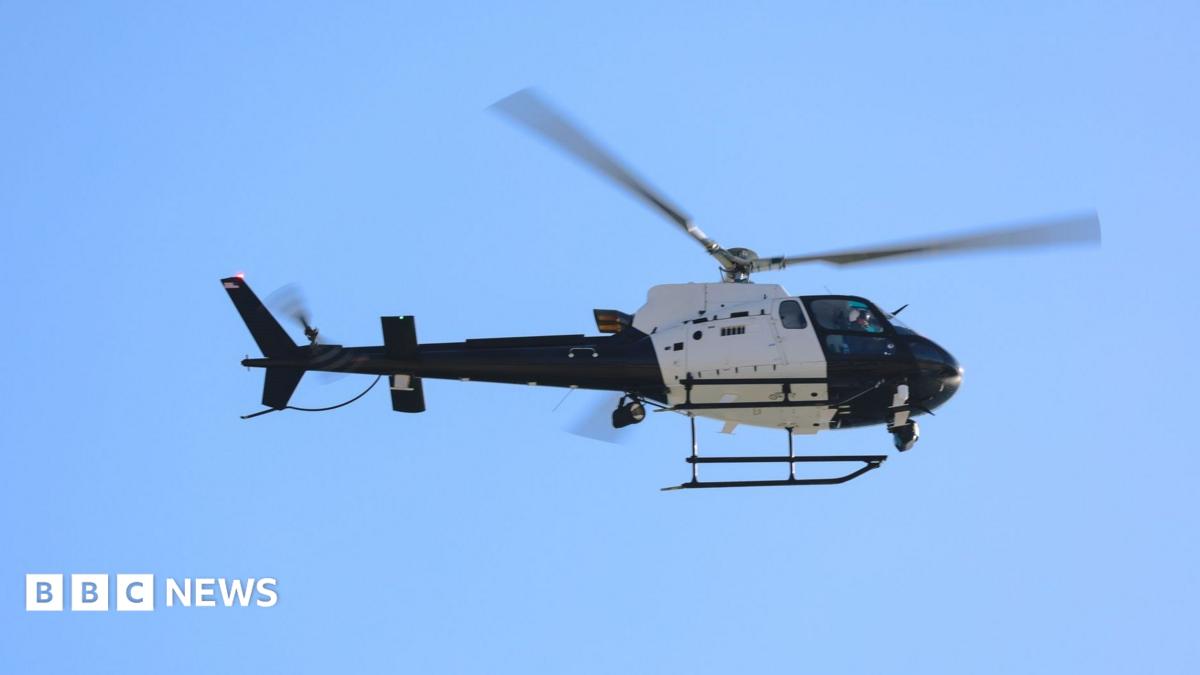
Four people have died following a helicopter crash in a small Quebec town about 50km (31 miles) from Montreal, provincial police have confirmed. The aircraft came down in flames in a rural area near Sainte-Brigide-d'Iberville on Saturday afternoon, and its occupants were pronounced dead at the scene, according to Quebec's Sûreté du Québec.
The crash site was located near the Rang des Écossais road, off Highway 10 — the highway that runs southwest from Montreal toward the Eastern Townships. The location places the wreckage in open countryside a short distance from a town of a few thousand residents, a setting that allows relatively easy access for emergency crews by road while also making the initial response a matter of reaching a scattered, unpopulated site.
Emergency services were dispatched to the municipality shortly after 14:30 local time on Saturday afternoon, which corresponded to 19:30 BST in the UK. In the emergency call, police were told that a helicopter was in distress and may have crashed and caught fire, an account consistent with what responders found on arrival: an aircraft on fire and its occupants already deceased.
The blaze at the site was brought under control roughly an hour after the call was made. Investigators and emergency personnel nonetheless remained at the crash site for several more hours, with officials still working there shortly before 22:00 local time (03:00 GMT). Such scenes typically require extended stays, as investigators photograph and map debris, document the position of wreckage and its spread across the ground, examine fuel and other residues, and remove components that may later be relevant to determining what went wrong.
Sergeant Audrey-Anne Bilodeau, speaking for the provincial police, said the victims had not yet been identified and that the aircraft appeared to be a private helicopter rather than a commercial airliner or a chartered flight. She cautioned that establishing the identities of those killed "may take a few days" — a timeline that reflects the painstaking work of matching physical evidence, flight and registration records, and missing-person reports.
The criminal investigation is being led by the Major Crime Unit of the Sûreté du Québec, working alongside crime scene technicians and investigators from the Transportation Safety Board of Canada. That combination of police and federal aviation investigators is standard in Canada, where a serious accident or loss of aircraft typically draws two parallel inquiries running side by side.
The two mandates are distinct. Police officers assess whether criminality — anything from impairment by alcohol or drugs, to reckless flying, to a mechanical problem caused by deliberate sabotage — might be involved, and they secure the scene and the evidence. The Transportation Safety Board concentrates on the circumstances of the flight itself, examining airworthiness, maintenance records, flight data, weather conditions, and the airworthiness of the pilot and crew, in order to establish causes and, where warranted, to recommend safety measures. Neither body announces conclusions prematurely, and initial police comment is generally limited to what is visible at the scene.
Investigators are also expected to consider the possibility of flight conditions, mechanical failure, or other causes without settling on any of them, and it is not yet known why the aircraft went down. No official account of the sequence of events leading to the crash has been released, and no findings from the Safety Board have been published.
Attention will now turn partly to the aircraft's registration and flight history, which are expected to help establish who was aboard, whether anyone else was involved, and where the helicopter had been flying before it crashed. Families of the dead are generally notified through police channels once identifications are confirmed, and the identification period described by Sergeant Bilodeau points to a process that may run past the weekend.
The broader setting is a small community on the fringe of a densely populated metropolitan region — the kind of commuter and general-aviation corridor where private helicopters and small aircraft operate routinely. Because Sainte-Brigide-d'Iberville sits in agricultural territory at the edge of the built-up area, the emergency response drew on rural fire and paramedic crews alongside provincial police.
The crash was reported to the BBC by Quebec's provincial police. The image accompanying the report is a file photograph illustrating a helicopter and is not from the crash site, and no footage or images of the wreckage have been released publicly. Reports of a crash and fire in a remote location can prompt witnesses or residents with photographs or video to come forward, although officials have not said whether any such material has been received.
For now, the four people who died have not been named, and the cause of the crash remains undetermined. Both the Major Crime Unit and the Transportation Safety Board of Canada will continue their work in the days ahead, with any account of what happened likely to emerge only after investigators have finished documenting the site, identified the victims and reported them to their families, and reviewed the aircraft's records.






(0)