
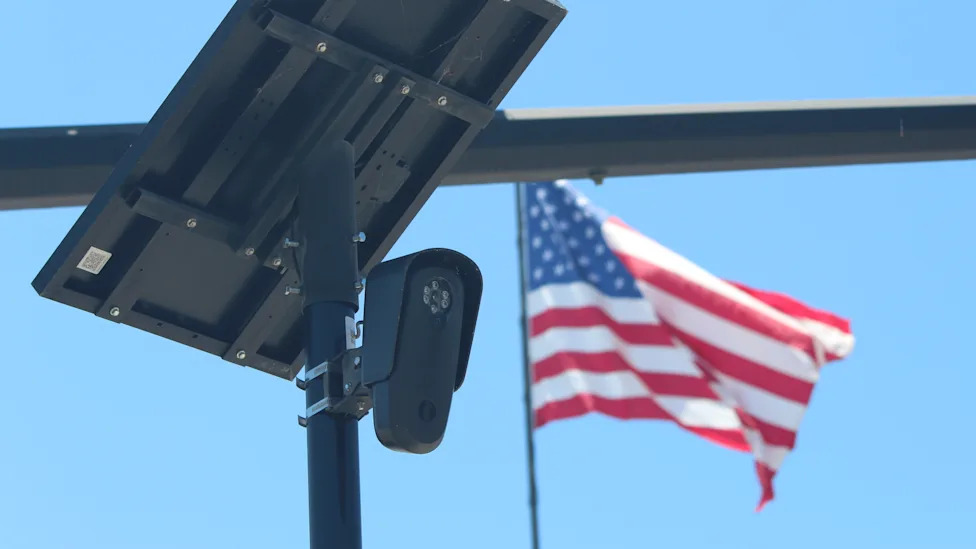
Law enforcement authorities across Ohio’s Miami Valley are actively investigating several recent incidents involving the criminal destruction and defacement of Flock automated license plate reader cameras. The targeted acts of property damage have brought renewed focus to the sharp friction between automated surveillance policing and rising community concerns regarding digital privacy, government tracking, and potential system misuse.
The Fairborn Police Department is spearheading the criminal investigations into the localized attacks, which took place across neighboring jurisdictions within the region. Investigators are currently working to determine who is responsible for deliberately disabling the high-tech optical devices positioned alongside public roadways.
Among the specific locations targeted by vandals was a surveillance camera installed within military housing in the city of Riverside. In that incident, perpetrators forcefully ripped the automated camera unit directly from its mounting pole, leaving the sensitive hardware dangling uselessly by its exposed electrical wiring.
Approximately ten minutes away along Kauffmann Road, another surveillance unit was rendered completely inoperable through deliberate vandalism. In that case, the camera was heavily coated with paint, while the mounting pole itself was defaced with the sprayed message "No Flock" to signal opposition to the monitoring program.
The physical attacks against the camera systems have drawn criticism from local community members who argue that damaging infrastructure is an unacceptable and illegal method of protest. Riverside resident David Lutzweit voiced strong disapproval regarding the property damage, asserting that destructive acts are an entirely inappropriate way for individuals to demonstrate their displeasure with technological initiatives.
Lutzweit emphasized that citizens who harbor objections to automated plate readers should instead rely on official democratic processes to air their grievances. He urged concerned residents to attend local city council meetings, communicate directly with their elected leaders, and participate in open civic debate, noting that vandalizing equipment is not an acceptable remedy and constitutes a crime.
In addition to condemning the criminal destruction, Lutzweit expressed personal support for the continued utilization of license plate recognition tools by municipal police forces. He explained that automated readers serve as valuable investigative instruments that assist law enforcement in solving crimes, adding that any technological capability that aids police in protecting the public represents a beneficial asset.
The vandalism in southwestern Ohio comes amid a massive nationwide expansion of Flock automated license plate readers. The company's vehicle tracking technology is currently deployed in more than 6,000 communities across forty-nine states, leaving Alaska as the only state without an active network installation.
Despite this extensive operational footprint, the proliferation of vehicle tracking systems has ignited substantial political debate throughout Ohio. Candidates currently campaigning in the state's gubernatorial race have increasingly highlighted the surveillance network, calling for the implementation of strict new legal safeguards and enhanced oversight to protect citizen privacy.
Growing skepticism regarding the automated cameras has also prompted direct policy action by local municipal leaders. Earlier this year, the city of Dayton made the decision to completely remove its municipal network of Flock cameras after community pushback and mounting reports regarding procedural issues and data misuse.
Public unease has been further amplified by documented instances of internal misconduct involving law enforcement personnel who had administrative access to plate reader networks. In Dayton, a police officer resigned from the force after an internal affairs investigation revealed that he failed to adhere to established departmental protocols while managing the automated camera system.
Concerns surrounding the unauthorized use of surveillance databases have surfaced in other jurisdictions as well. In New York, a sheriff’s office investigator is currently facing criminal charges after being formally accused of conducting more than 4,000 unauthorized and improper vehicle searches utilizing the Flock camera network.
Conversely, prominent state officials continue to emphasize the life-saving capabilities and investigative benefits offered by the automated monitoring systems. Speaking at a law enforcement symposium held in Dayton on Monday, Ohio Attorney General Andy Wilson defended the technology by highlighting a recent case in Miami County, where data from a Flock camera helped police quickly locate and rescue a suicidal individual.
In response to the recent property destruction, Flock issued a statement formally condemning the sabotage of its equipment in the Miami Valley. A company spokesperson stated that defacing and disabling automated cameras ultimately harms and endangers the very communities the public safety technology was deployed to protect.









(0)