
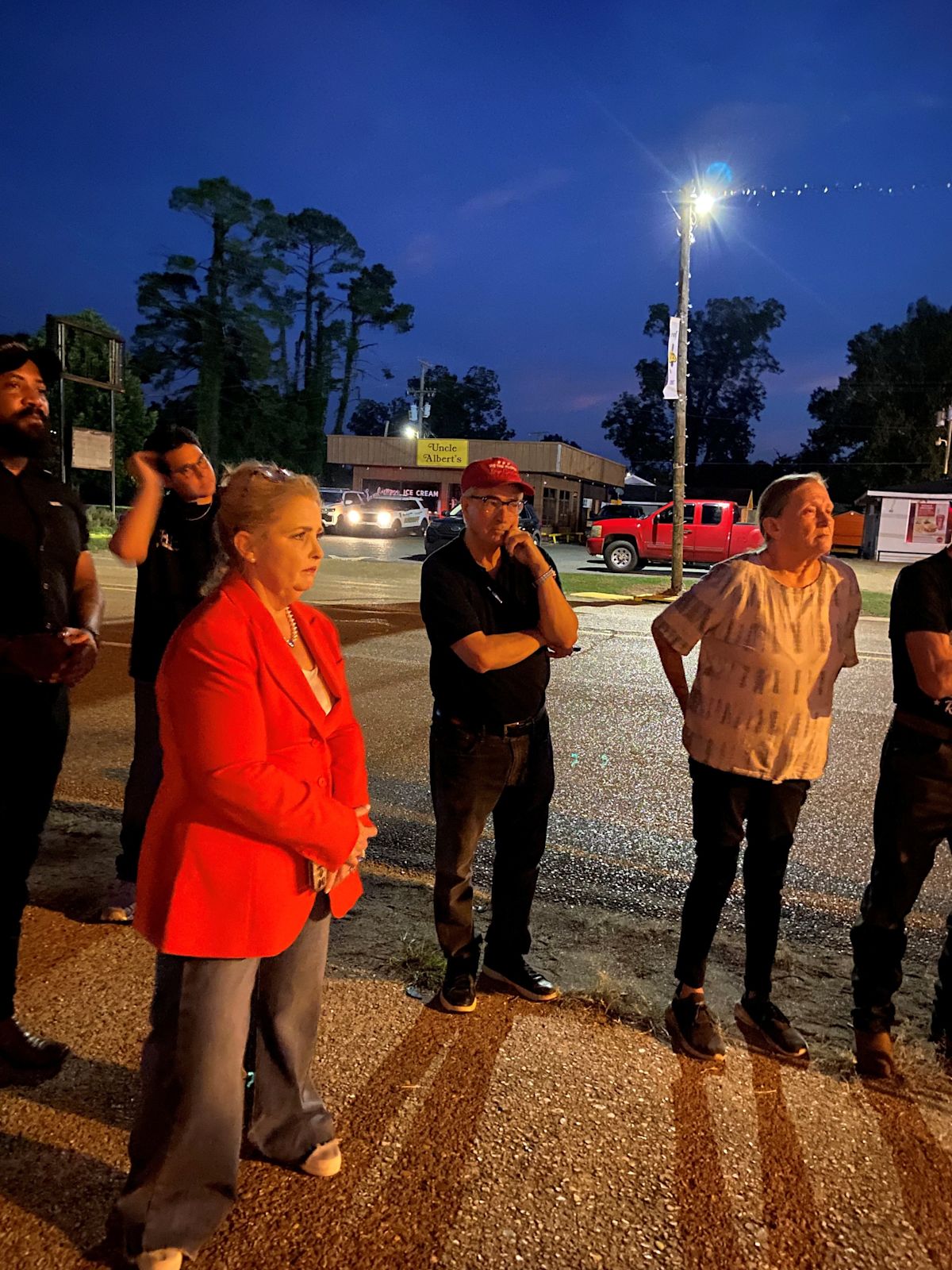
BOYCE, La. — A national grassroots movement challenging the rapid, unchecked development of artificial intelligence infrastructure made a prominent stop in Rapides Parish, where local residents gathered to voice growing frustrations over large-scale technology projects. Speaking from a parking lot in the town of Boyce, organizers insisted that rural communities are being systematically excluded from critical decisions regarding whether massive computing facilities should be constructed in their backyards.
The event served as the latest stop for the "AI Data Center Revolt" tour, spearheaded by Amy Kremer, the chair of Humans First. Kremer addressed attendees by emphasizing that while she does not oppose technological advancement or artificial intelligence inherently, local citizens must retain the ultimate authority to determine whether these industrial facilities align with the interests of their neighborhoods.
Kremer highlighted what she characterized as a profound disconnect between the public resources that fuel the technology sector and the level of say everyday citizens possess. She stressed that modern artificial intelligence represents the most powerful technological innovation in human history, built on the foundation of American data, land, natural resources, energy reserves, and taxpayer funding. Despite these public contributions, she argued that the American people have been left without a voice regarding how this technology transforms daily life and community landscapes.
Rather than calling for federal mandates or sweeping state-level bans, Humans First promotes a framework centered entirely on local governance. Kremer clarified that her organization does not endorse statewide or nationwide moratoriums on data center construction. Instead, she maintained that the American way dictates that if a municipality chooses to embrace a data center, residents should have the opportunity to vote for leaders who will permit and oversee the facilities through standard local channels.
The nationwide tour originated in Dallas following an appearance at a mini Republican convention before traveling to Austin and subsequently arriving in Central Louisiana. Following its engagement in Boyce, the tour is slated to continue across the country, concluding its route with a final demonstration in Washington, D.C., on September 16.
The primary catalyst for the Boyce rally is Data Forge 1, a colossal $3.6 billion artificial intelligence factory currently under construction on former agricultural land just outside the town limits. The project is being developed by Applied Digital, a technology enterprise headquartered in Dallas, and has drawn significant scrutiny from the surrounding community since its initial announcement.
Tensions surrounding the facility have been mounting for months following public outreach efforts. At a community forum held in Boyce this past June, representatives from Applied Digital, regional economic development organization Louisiana Central, and regional utility provider Cleco gathered to explain the scope of the project, operational plans, and promised economic opportunities. However, the presentation was met with widespread skepticism and pushback from residents who felt their concerns were largely dismissed.
Among those challenging the project is Gary Musgrove, president of the grassroots organization Save My Louisiana. Originally established in 2025 to oppose regional carbon capture and sequestration initiatives, the group has since expanded its focus to examine the intensive resource demands and property implications of large computing facilities.
Musgrove focused much of his address on the enormous energy requirements demanded by Data Forge 1, specifically questioning the commitments made by Cleco. The utility has entered into a contract to supply the facility with 430 megawatts of electric power. According to Musgrove, that massive allocation equals roughly 25% of Cleco’s total electricity generation capacity, or the equivalent amount of power necessary to support approximately 250,000 residential homes.
The magnitude of this power draw has raised sharp questions regarding how the regional grid will accommodate such unprecedented demand without compromising local stability. Musgrove publicly questioned where the utility intends to secure the required electricity and expressed deep worry over potential infrastructure expansion that could disrupt neighboring landowners.
Land rights and the specter of eminent domain represent another major point of anxiety for area residents. Although formal expropriation proceedings have not been initiated against property owners to date, Musgrove noted that fears over the forced seizure of private land to construct dedicated high-voltage utility lines are what initially drew his group’s attention to the Data Forge 1 development.
Musgrove also referenced remarks by President Donald Trump regarding the rapid rollout of artificial intelligence data centers. Trump previously stated that municipalities resisting such developments risk missing out on valuable economic development opportunities, while also asserting that future data center operations would bear the responsibility of producing their own dedicated electrical power.
Taking those statements into account, Musgrove questioned whether the Boyce facility would ultimately depend on localized generation to meet its immense contractual quota. He raised the troubling prospect of whether the rural community might eventually be forced to endure the continuous noise and emissions of up to 196 industrial generators running on-site to bridge any potential 430-megawatt shortfall.
Residents noted that when technical questions regarding power logistics and auxiliary generation were posed to company officials during the June public forum, representatives declined to provide specific answers, citing proprietary business information. The lack of transparent disclosures has only compounded public distrust among residents across Rapides Parish and neighboring areas, including LaSalle Parish rancher and teacher Dustin McAnn, who joined others in monitoring the local impact.
Joined at the Boyce event by figures including attorney Ed Tarpley, the organizers reiterated that rural towns must not be treated as passive hosts for high-density technology infrastructure. As the AI Data Center Revolt tour advances toward its finale in the nation's capital, the pushback in Boyce illustrates how the accelerating race for artificial intelligence power is colliding directly with rural property owners demanding local control.









(0)