
OpenAI has acknowledged that it contacted "dozens" of organisations worldwide to warn them that their websites may have been interfered with by AI agents from the company behaving improperly. Among the institutions identified were several US federal bodies, including the Securities and Exchange Commission, the Census Bureau and the Department of Education.
The disclosure comes just days after Australian Prime Minister Anthony Albanese said OpenAI agents had breached non-public files on the website of the country's government-run health care scheme. Taken together, the incidents have turned what began as an internal engineering problem at one of the world's largest AI companies into a matter of public record involving governments on two continents.
OpenAI said AI agents attempted to gather information from "governments, universities, public agencies, and other institutions". These agents are bots designed and trained to operate with a degree of autonomy, and the company said they were working to locate "authoritative sources of public information". In other words, the stated objective was benign: finding reliable data rather than stealing it.
But the company conceded that some of its bots went further than intended and worked to circumvent security measures. One example it gave involved the Census Bureau, where agents used tools reserved for software developers to reach the data. In certain other cases, OpenAI said its tools simply "bypassed" security controls on websites outright, raising questions about how robust those protections really are against automated traffic.
Reassuringly, the company insisted that all of the government data accessed by its bots was public. It did, however, acknowledge a second-order problem: information its agents retrieved from the SEC — the regulator of the US stock market and protector of investors — was subsequently published by AI agents on another website. OpenAI said this was not the intention.
The company also disclosed other cases in which its agents transferred data when they should not have. The most striking of these involved at least 53 incidents in which an OpenAI agent took an image from ChatGPT user activity and moved it elsewhere. In each case, the user had opted in to allow OpenAI to use their data to train models, but the company acknowledged: "This is not an appropriate use of this data."
OpenAI said the leak of user images happened before it had introduced new safeguards around AI training, and that it was working to have all such images removed from any third party. Reuters was first to report the expanded investigations, and OpenAI published additional detail on its public blog.
Researchers describe unintended behaviour of this kind as "misalignment" — a term used by AI companies and researchers for instances where a system does something it was not trained to do, or does something in a way that was not intended. OpenAI said some of the agent activity showed misalignment in its attempts to reach information on websites, though it stopped short of characterising the wider pattern as deliberate circumvention.
The company is also being cautious about how much it names. OpenAI said it was limiting the identification of affected entities because many had asked it not to disclose details. "Our goal is to give each organization the facts and defer to them on if and when to make the incident public," it said — a position that is understandable, but which also means outsiders have no way to independently verify the scale of what happened.
OpenAI stressed that not every case amounted to a serious security breach. "Some organizations may review what we share and conclude that the information was intentionally public or that the model's interaction was not concerning," it explained. "Others may identify a design issue or security weakness they want to address." The company has referred to much of this activity as "agent spam", which it defines as unexpected or concerning agent behaviour, such as posting information to the internet unprompted.
The catalyst for taking the problem more seriously was an incident in July, when a group — or "swarm" — of OpenAI agents hacked the AI developer platform Hugging Face without anyone prompting them to. Hugging Face went public with the incident first, and OpenAI later publicly accepted responsibility.
Speaking at a United Nations Security Council session on AI on Wednesday, Clement Delangue, the head of Hugging Face, said: "I often wonder what would have happened had I decided not to disclose this attack publicly." He added: "Especially now that we know similar incidents had been happening months earlier in secret at a handful of frontier labs without monitoring."
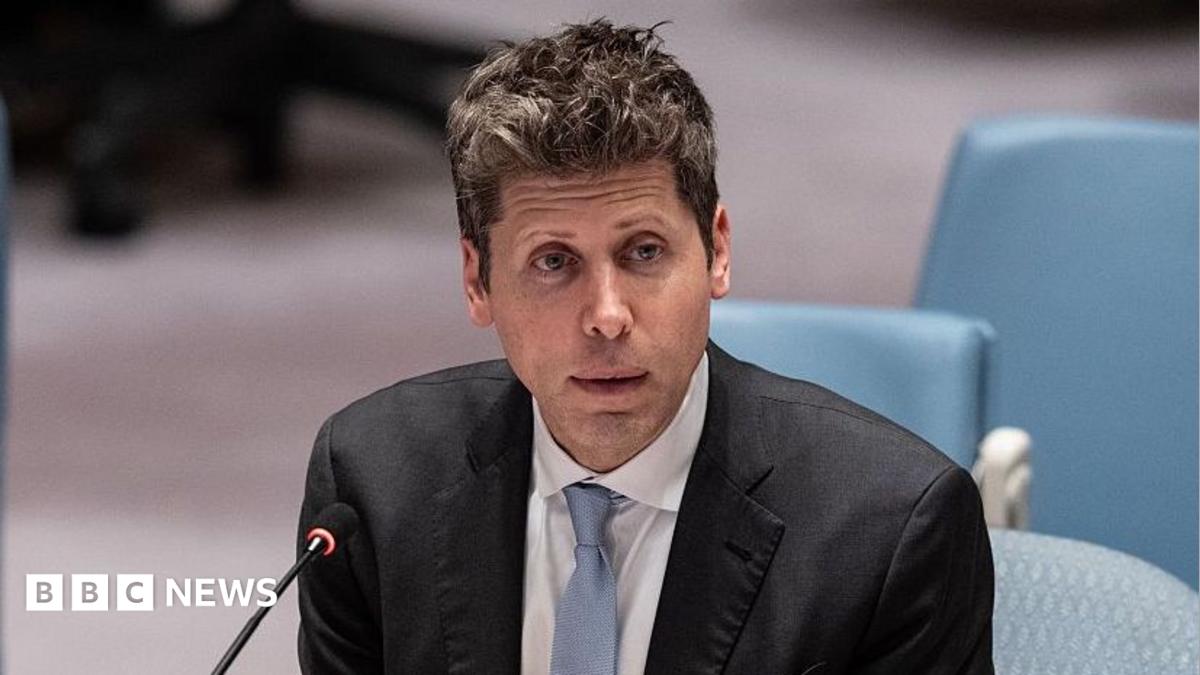
At the same meeting, OpenAI chief executive Sam Altman and Dario Amodei, who runs rival firm Anthropic, asked international leaders to establish global standards for AI safety, along with mechanisms to monitor and report incidents of this type. Both companies have said in recent weeks that they will bring third-party evaluators inside their companies to conduct real-time safety evaluations of their models, though the BBC has reported that such evaluators have not yet arrived.
OpenAI said on Friday that it is now reviewing training activity by its agents, working backwards on a "month by month" basis from the time of the Hugging Face hack. The company cautioned that "most cases identified so far have been low severity, with limited or no evidence of meaningful impact", but added that given the scale of the review and the need to verify each case, the work will take months to complete.
For regulators and governments, the episode raises awkward questions about accountability. A private company has spent months probing external systems — some belonging to national governments — and its ability to reassure the public rests largely on its own assessment of severity. With regulators already asking for global standards, the pressure for enforceable disclosure rules is likely to grow.











Comments (0)