
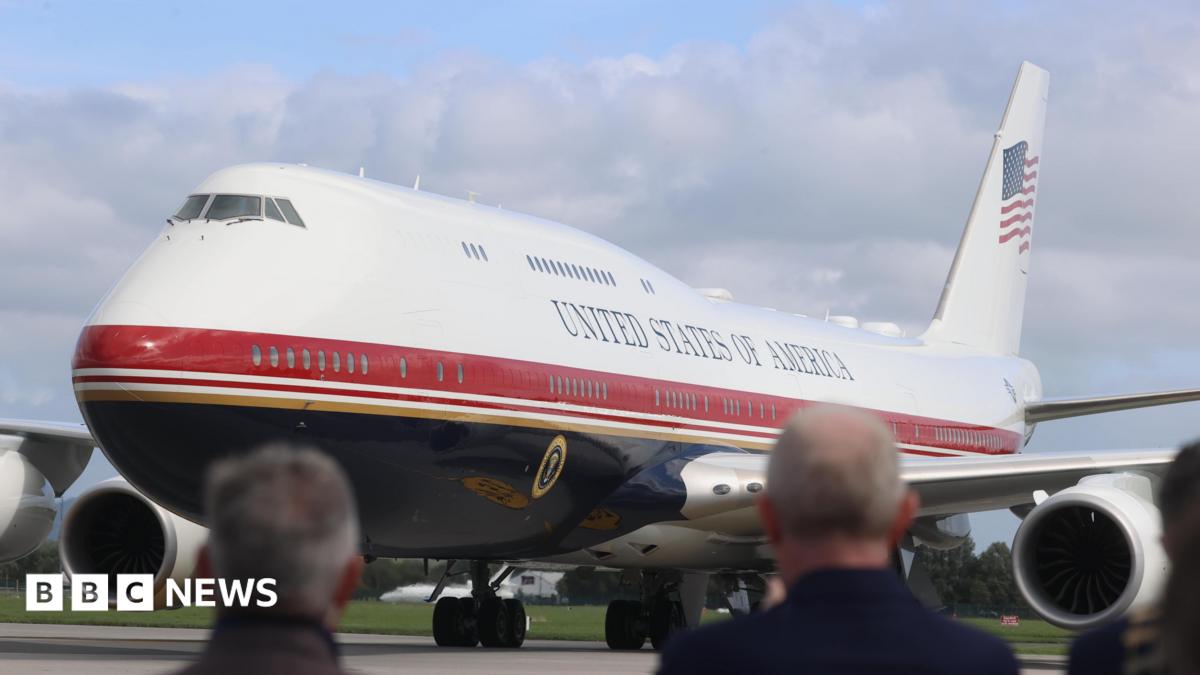
President Donald Trump's administration has barred CNN from travelling with him on Air Force One for a weekend trip to Tennessee, marking another escalation in the running dispute over the White House's treatment of the news media. The restriction was confirmed in a media schedule released on Friday night, roughly a day after regular television coverage of the president resumed.
CNN had been scheduled to accompany the president aboard Air Force One as he travelled to a college American football game. The broadcaster was omitted from the White House's list of outlets cleared to fly with him, and CNN reported that no other organisation had been named as a replacement on the tentative schedule. The BBC has asked the White House for comment on the decision, which was not accompanied by a stated reason in the schedule itself.
The trip takes place on Saturday, with Trump due to attend a game between the University of Tennessee and the University of Texas at Neyland Stadium in Knoxville, kicking off around midday local time. Such travel on the presidential aircraft has long been treated as a prime access opportunity, allowing a small pool of correspondents to question the president in an informal setting and to capture the more choreographed spectacle of a presidential departure.
The move comes in the wake of a week in which the White House was forced by a federal judge to partially reverse course. Trump had banned journalists from CNN, Politico and MS NOW from the White House after accusing them of writing "fiction or lies" about his administration. All three outlets said they were pursuing legal action and accused him of violating their constitutional rights to freedom of speech and freedom of the press.
Support for the banned outlets came from within the industry. Four television networks that share a daily rotation of White House coverage alongside CNN — ABC, CBS, Fox News and NBC — paused their broadcasts of the president in solidarity with the excluded organisations. The walkout drew wide attention to the unusual sight of major US networks going dark during a regular scheduled appearance, and it briefly placed pressure on the administration to resolve the standoff.
As the ban took effect, the White House also launched its own streaming channel, Trump TV, ahead of the United Nations General Assembly in New York. The service was widely seen as an attempt to bypass traditional outlets and distribute the president's remarks directly to the public, at a moment when several established news organisations were excluded from the building.
A federal judge subsequently ruled that barring news outlets from the White House was likely unconstitutional, and that the administration had to allow them back in — at least for now. The decision restored access for many correspondents, and regular US television coverage resumed on Friday once White House officials permitted reporters to re-enter the premises.
The ruling, however, did not end the friction. On Thursday, the White House still refused entry to some CNN and MS NOW reporters who had been assigned to cover the arrivals of Chinese leader Xi Jinping at a state dinner. That refusal prompted a response from a White House communications account on X, which said that "contrary to what the Fake News wants you to believe, they don't just get to have free rein into every part of the White House, every event and every press call."
The statement captures the administration's position: that the judicial ruling obliged it to restore access to the White House, but did not guarantee journalists unfettered entry to every room, event or press call on its property. Officials have therefore framed the subsequent exclusions as a matter of curating access rather than a continuation of the blanket ban struck down in court.
Analysts of the dispute note the tension between the two lines the White House is drawing. If the court order is treated as a command to reinstate the banned outlets, then selectively removing the same organisations from a presidential trip looks less like curatorial discretion and more like a workaround. That question — whether access granted under compulsion can be lawfully withheld again on a case-by-case basis — is likely to be tested in the lawsuits the outlets have already filed.
For the excluded broadcasters, the practical cost of the pattern is significant. Access to Air Force One offers visibility and exclusivity that correspondents cannot replicate from the ground, and the opportunity to put questions directly to the president is comparatively rare. Losing it for a single trip sets a precedent that can be applied repeatedly, even if each individual decision appears small.
The coming week is unlikely to settle matters. Trump remains in the middle of a sustained legal and public-relations contest over press access, with litigation pending, television coverage restored but conditional, and the administration's own media channel competing for attention. The Tennessee trip is the first clear test of whether the Air Force One exclusion was a one-off or part of a broader pattern, and whether the White House will face further pushback from the four networks that acted in solidarity last week.





Comments (0)