
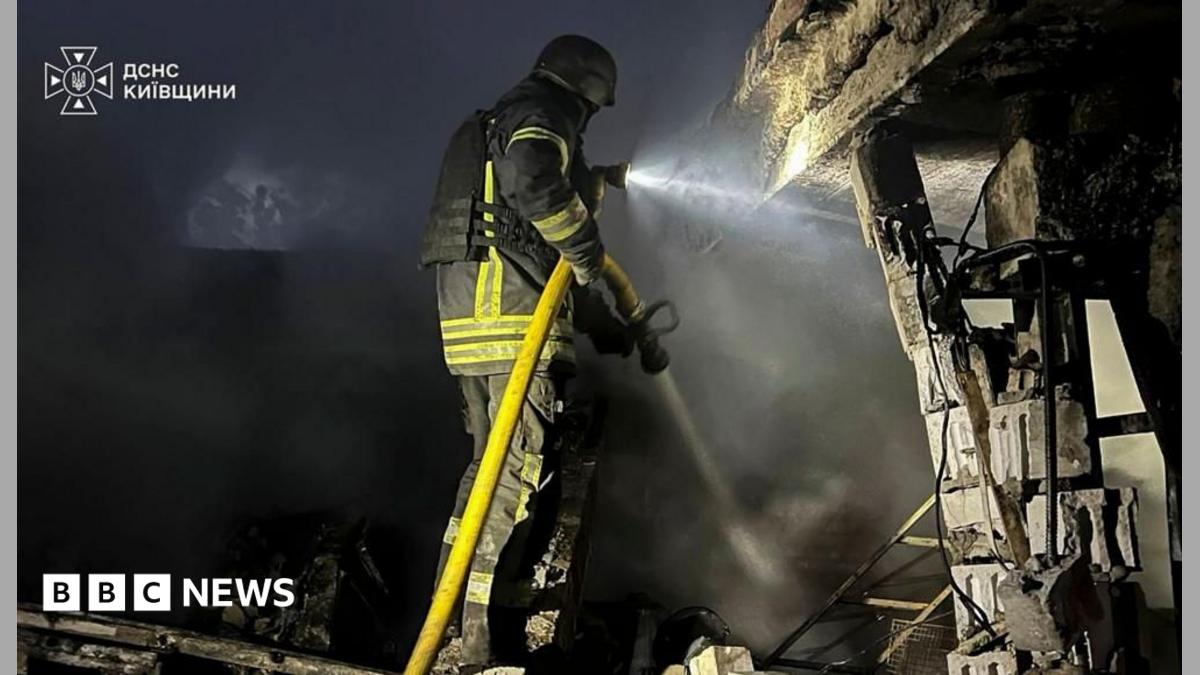
Russia has carried out its most extensive assault on Ukraine's energy infrastructure in months, firing a large wave of missiles and drones primarily at Kyiv and the surrounding region, according to Ukrainian Prime Minister Serhiy Koretskyi. The overnight bombardment, described by officials as a "mass and combined attack," marks a significant escalation in Moscow's campaign against civilian utilities as the country braces for another punishing winter.
At least six people were killed and 33 others wounded across Ukraine during the attacks, local authorities confirmed. Among the dead was a child whose body was recovered from beneath the rubble of a destroyed house in the Kyiv region, according to regional governor Timur Tkachenko. The toll underscored the deadly reach of the strikes, which extended well beyond the capital.
Kyiv Mayor Vitaly Klitschko reported that three people lost their lives in the capital itself. One of the victims was a utility company employee killed when a warehouse building was hit. It remained unclear whether the three fatalities cited by Klitschko included the child identified by the regional governor, highlighting the confusion that often accompanies the immediate aftermath of large-scale attacks.
The assault also inflicted heavy damage on Ukraine's power network. DTEK, the country's largest private energy company, said electricity had been restored to 8,000 homes following what it called "a difficult night" for Kyiv. The Russian defence ministry claimed that the Trypilska power station, the single largest supplier of electricity to the capital, was among its targets. Ukrainian officials have not confirmed that claim.
Writing on Telegram, Prime Minister Koretskyi stressed the unprecedented nature of the strike within recent months. "Since the summer, there has effectively not been a single day without enemy attacks on our energy infrastructure," he said. "However, a mass and combined attack of this scale has occurred for the first time since the end of the last heating season." His remarks suggested that while smaller, persistent strikes have become a grim routine, the coordinated scale of this particular operation represented a new and more dangerous phase.
In total, 11 regions of Ukraine were attacked overnight, according to Koretskyi. Beyond energy facilities, the strikes damaged residential buildings, social infrastructure, civilian enterprises and railway networks. President Volodymyr Zelensky said critical infrastructure had been hit in the Zhytomyr, Mykolaiv, Kirovohrad and Rivne regions, illustrating the geographically dispersed nature of the assault.
The human cost extended beyond Kyiv. Two people were killed in the north-eastern Sumy region, according to governor Oleh Hryhorov, while acting regional governor Heorhiy Reshetilov confirmed another fatality in the Mykolaiv region. The breadth of the casualties across multiple regions reinforced the sense that this was not a narrowly focused military operation but a nationwide bombardment.
By Wednesday morning, households in the Kyiv, Dnipropetrovsk, Donetsk, Sumy and Kharkiv regions were still without power, the energy ministry reported. State-owned grid operator Ukrenergo urged residents to refrain from using high-powered electrical appliances between 10:00 and 16:00 local time because electricity supplies were running below normal levels. The advisory reflected the delicate balance grid operators face in keeping the system from collapsing entirely.
In Kyiv, residents awoke to a city shrouded in thick, acrid smoke after a night punctuated by the sound of explosions. An air raid alert remained in effect, and the distant echo of air defence gunfire reverberated through the murky atmosphere. Authorities in several districts advised people to keep their windows closed until the smoke dissipated, a stark reminder of the immediate health hazards that accompany attacks on industrial and energy sites.
The timing of the assault is deeply concerning for Ukrainian officials, who have long anticipated a renewed Russian effort to cripple the national grid. Such campaigns have been launched every winter since Russia's full-scale invasion in 2022, part of a broader strategy to break civilian morale by depriving homes of heat, light and water during the coldest months. With autumn underway, this attack may signal the opening salvo of a concerted seasonal offensive against the power system.
Moscow's strategy of targeting energy infrastructure has drawn widespread international condemnation as a potential violation of the laws of armed conflict, given the disproportionate impact on civilians. Yet the Kremlin has shown little sign of relenting, framing such strikes as legitimate military operations against facilities that support Ukraine's defence capabilities.
Analysts note that Ukraine's air defence forces remain under severe strain, forced to prioritise which incoming threats to intercept as Russia deploys a mix of cruise missiles, ballistic missiles and drones. The sheer volume of projectiles in a massed attack can overwhelm even sophisticated defensive systems, allowing some to slip through and strike their intended targets. Western-supplied air defence systems have helped, but Kyiv has consistently appealed for more.
The broader strategic picture remains grim. Russian President Vladimir Putin ordered the full-scale invasion of Ukraine in 2022, and Moscow currently controls roughly 20 percent of Ukrainian territory. With no clear end to the fighting in sight, the targeting of energy infrastructure appears designed to erode Ukraine's resilience on the home front while Moscow's forces press ahead on the battlefield.
For ordinary Ukrainians, the coming weeks will bring renewed uncertainty. Power outages, heating disruptions and the constant threat of aerial attack are once again becoming part of daily life. The overnight barrage serves as a stark reminder that as winter approaches, the battle for Ukraine's energy grid — and the civilian population that depends on it — is set to intensify.







(0)