
The United States has removed every bomber stationed at RAF Fairford, the Gloucestershire airbase that has become the focus of a counter-terrorism investigation following a security scare late last month. A statement from a US department official confirmed on Sunday that the aircraft — believed to number around a dozen B-1 Lancer heavy bombers — had been flown back to their home stations in America.
The withdrawal was not accompanied by any official explanation from Washington, but it comes in the wake of a major incident on 27 September, when police were alerted to three suspicious vehicles close to the perimeter of the base. Five men were initially detained on suspicion of terror offences near the site and were later released on bail. A sixth man, described as a UK-Iranian national aged 25, was arrested in London several days afterwards and was also released on bail, counter-terrorism police confirmed on Saturday.
Whitehall sources have not disputed that the decision by Washington was a direct response to the events at the airbase. According to the BBC, the move was a military rather than a political one, taken at an operational level and communicated from the US military to its British counterparts. The UK's Ministry of Defence has declined to comment on the matter.
Flight-tracking websites showed B-1 bombers departing RAF Fairford on Sunday, providing visible confirmation of the withdrawal. The aircraft are understood to have returned to their permanent bases in the United States, ending a deployment that had placed the long-range strike force at the heart of recent US operations in the Middle East.
The incident that triggered the alert unfolded in the early hours of 27 September, when vehicles were reported to be travelling towards the base, which is operated by the US Air Force. Five men aged between 23 and 25 were arrested. All five were UK nationals from London. They were initially held on suspicion of explosives offences and later on suspicion of preparing a terrorist act, before being released on bail in what police described as an "investigative decision" grounded in experience and strategy.
The sixth suspect was arrested in London on Thursday on suspicion of preparation of terrorist acts. Counter-terrorism police confirmed on Saturday that he had also been released on bail. No charges have been brought against any of the six men, and the investigation remains ongoing.
In the days following the incident, Prime Minister Andy Burnham said there were "strong indications" that Iran had played a part, though he did not elaborate on the evidence behind that assessment. Tehran has strongly denied any involvement in the episode.
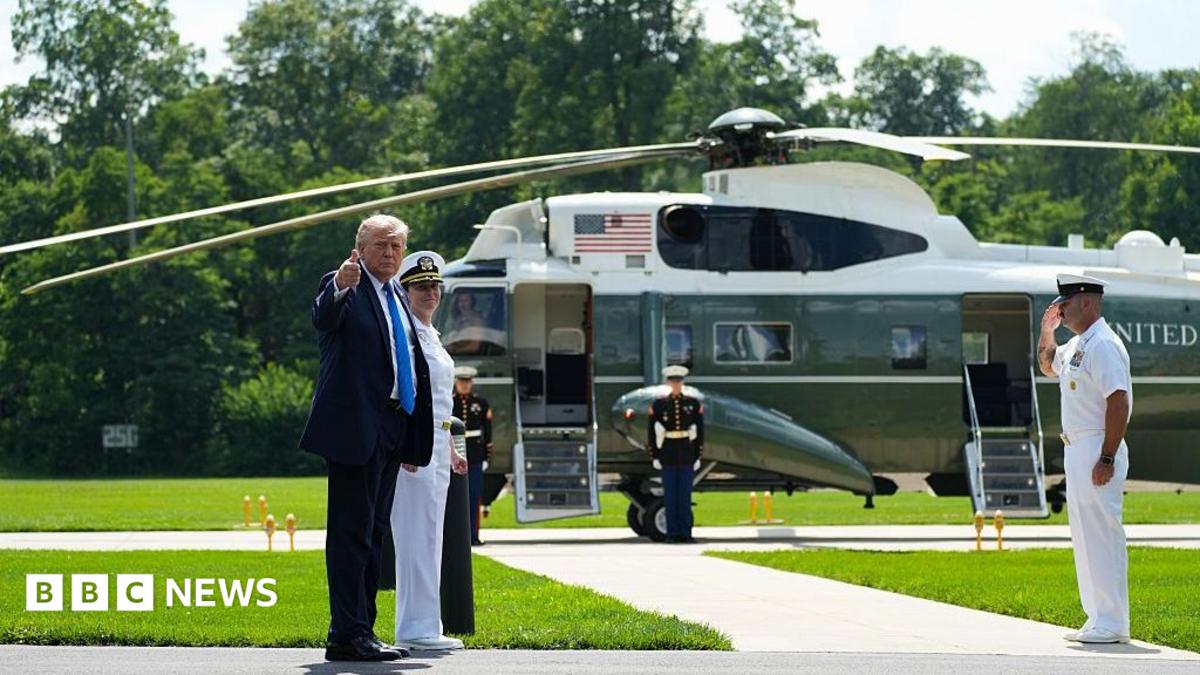
US Secretary of State Marco Rubio also weighed in, telling Fox News that the incident "clearly involve[d] the hands of a foreign actor". He declined to provide further details, saying he was limited in what he could disclose on air. President Donald Trump separately expressed surprise that the five men had been released on bail, stating: "We know everything about them, we would not have released them." He added that the UK had worked with the US "very closely" on the matter.
RAF Fairford has served as a forward operating location for the US Air Force for decades and has long been a linchpin of American power projection from British soil. In recent months, the base has hosted both B-1 and B-52 bombers conducting operations connected to the Middle East, following the UK's approval of a US request to use the facility for defensive strikes on Iran.
That arrangement has not gone unanswered. In July, Iran stated that "any base used for aggression against Iranian territory constitutes a legitimate target for our forces" — a warning that lends additional significance to the security scare at Fairford and to the subsequent American decision to pull its aircraft out.
The B-1 bombers flown from the UK were, in many cases, armed with precision-guided "bunker-busting" bombs featuring thicker casings designed to penetrate hardened or deeply buried targets such as weapons stores. They also carried air-to-surface missiles intended for use against more heavily defended targets deeper inside Iran. Each bombing mission, depending on the target's location, would likely have taken around 12 to 15 hours in total there and back, with air-to-air refuelling required in both directions.
The Pentagon has stressed that its bombing aircraft remain able to conduct missions "anywhere, anytime", including through "operations that launch and recover from the continental United States" — a statement that may be intended to signal that the withdrawal from Fairford does not diminish American strike capacity.
The removal of the bombers nonetheless represents a notable moment in the episode. It follows a period in which the base has been central to US military activity and, more recently, to a counter-terrorism investigation that has drawn in British police, the Ministry of Defence and the intelligence services. The decision to relocate the aircraft appears to reflect operational risk assessments rather than a change in political alignment between London and Washington.
For the UK, the incident raises difficult questions about the security of US assets on British soil and the wider consequences of hosting aircraft used in operations against Iran. The base's proximity to civilian areas in Gloucestershire has long made it a focal point for protests and scrutiny, and the terror investigation is likely to intensify debate over the risks associated with such deployments.
The investigation itself remains active. Counter-terrorism police have not indicated whether further arrests are expected, and the release of all six suspects on bail means inquiries will continue without charges for now. What began as a report of suspicious vehicles near an airbase has grown into a case with international dimensions, touching on UK domestic security, the American military presence in Britain and the fraught relationship between London, Washington and Tehran.



(0)