
A landmark cultural institution in Texas has launched a sweeping culinary exhibition to commemorate its centennial anniversary. The Witte Museum’s newest installation, titled "Gather 'Round the Table: Texas Food Traditions," explores the rich history, regional heritage, and enduring dietary customs of the Lone Star State through an extensive collection of historical artifacts, immersive displays, and creative artisan showcases.
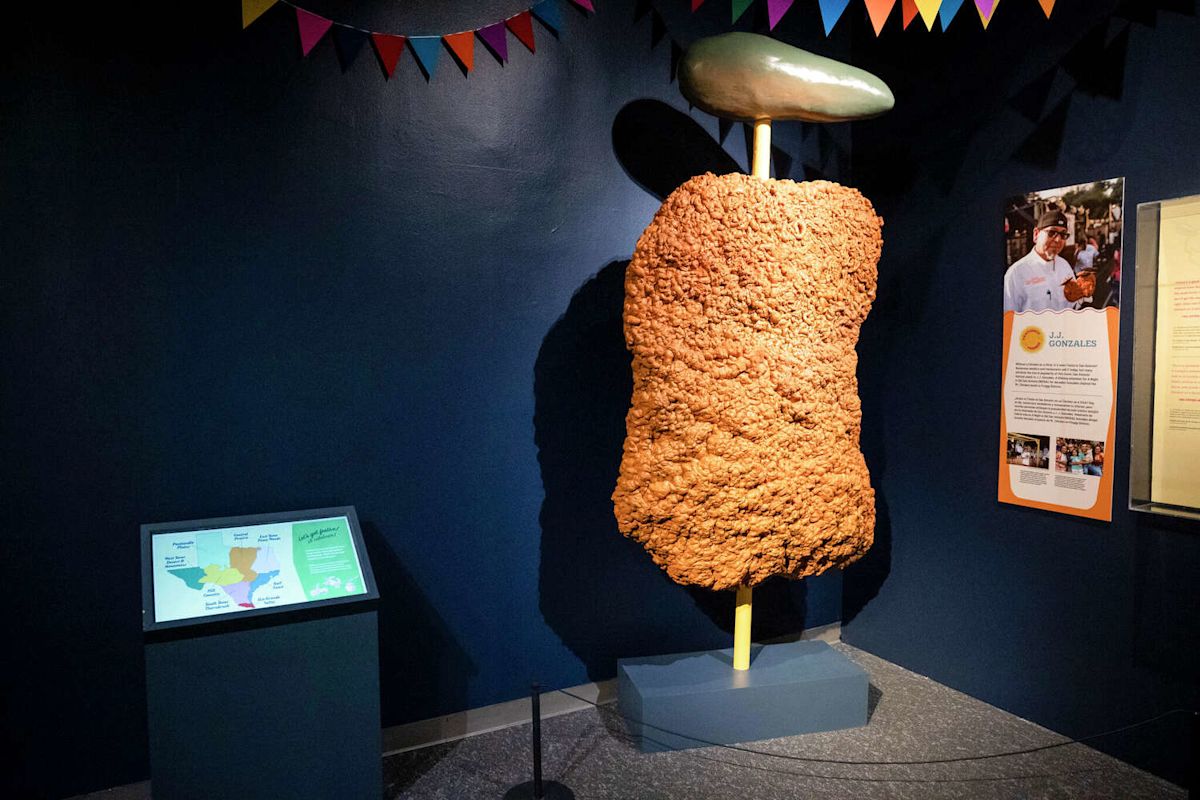
Standing out among the exhibition's most eye-catching highlights is an oversized, 10-foot-tall sculpture of a beloved carnival staple: chicken on a stick. Boasting a textured golden breading and crowned with a plump jalapeño perched atop a bright yellow skewer, the towering food replica provides a playful, larger-than-life tribute to the foods that define community gatherings and celebrations across Texas.
Despite its appetizing appearance, the colossal culinary work is entirely non-edible. Designed and assembled by Marcos Medellin, the Witte Museum’s director of exhibitions, the sculpture was crafted using practical workshop materials. Medellin constructed the massive display piece using leftover shop wood, chicken wire framework, insulation foam for volume and texture, and a sturdy PVC pipe core to anchor the skewer.
Scheduled to remain on public view through February 7, 2027, the expansive exhibition serves as a centerpiece for the museum’s 100th anniversary festivities. Rather than relying on traveling collections, the ambitious presentation was developed internally, spotlighting the institutional archives of the Witte as well as the specialized craftsmanship and research capabilities of its curatorial staff.
Michelle Everidge, the president and chief executive officer of the Witte Museum, praised the exhibition as a defining moment in the organization's century-long history. Everidge emphasized that producing large-scale, research-driven exhibitions completely in-house using the museum's own historical collections exemplifies the institution operating at its finest, making it a fitting centerpiece for the centennial milestone.
The towering poultry sculpture anchors a dedicated gallery space focusing on public fairs, carnivals, and cultural festivals. Museum leadership considered the inclusion of the dish essential to capturing modern regional traditions. Nalleli Guillen, the museum's vice president of interpretation and curator of history, noted that staff made it an absolute priority from the project's inception, remarking that a Texas festival food retrospective would feel distinctly incomplete without representing chicken on a stick.
Beyond festive gathering foods, the exhibition investigates the cultural and historical foundations of everyday cooking across the state. The galleries present accessible historical narratives explaining how regional ingredients and migration patterns shaped modern recipes, while also acknowledging classic, spirited Texas culinary rivalries, such as the preference between corn and flour tortillas or the ongoing debate between salsa and guacamole.
In addition to contemporary festival culture, the showcase includes rare artifacts that delve deep into natural history and agriculture. Among these historical treasures is an early 20th-century shadow box dedicated entirely to Texas pecans. The artifact reflects an era of intense botanical curiosity and pays homage to one of the state's most iconic agricultural staples and dessert ingredients.
The shadow box originated from the work of naturalist H.P. Attwater, who sought to document the immense diversity of the native nut. While more than 1,000 distinct varieties of pecans are known to exist, Attwater assembled and cataloged dozens of specimens. His preserved display organizes 50 separate pecan varieties arranged neatly in groups of three, accompanied by vintage typewritten labels that identify cultivars such as May Russells, sweetmeats, and delicate Mexican Papershells.
The pecan exhibit carries special institutional significance because it connects directly to the Witte Museum's origins. The shadow box is part of the broader Attwater Collection of Natural History, which represents the very first major acquisition made by the institution when it was established a century ago.
The founding of the museum and the acquisition of the Attwater materials were spearheaded by Ellen Schulz Quillin, a pioneering schoolteacher and botanist. To secure the collection for the community, Quillin orchestrated a purchase for $5,000, relying heavily on grassroots fundraising efforts that gathered nickels and dimes contributed by local schoolchildren eager to establish a municipal museum.
Specimens from Attwater’s natural history catalog were featured prominently when the facility initially opened its doors to the public on October 8, 1926. At the time of its debut, the institution was known as the Witte Memorial Museum, an official moniker it retained for nearly six decades until the word "Memorial" was formally removed from its name in 1984.
Complementing the historical artifacts and visual art, "Gather 'Round the Table" also integrates hands-on and multi-sensory educational displays. One interactive station invites visitors to explore regional seasonings firsthand by experiencing the distinct scents of eight different culinary spices that form the aromatic backbone of Texas cooking.
By combining foundational artifacts from the 1920s with modern sculptural centerpieces and interactive sensory elements, the exhibition encapsulates the evolving story of Texas gastronomy. The multi-year presentation offers visitors an expansive look at the social traditions, ingredients, and community histories that continue to shape the state's shared cultural table.







(0)